Do Not Call and TCPA for Phone Lists: What to Scrub and When
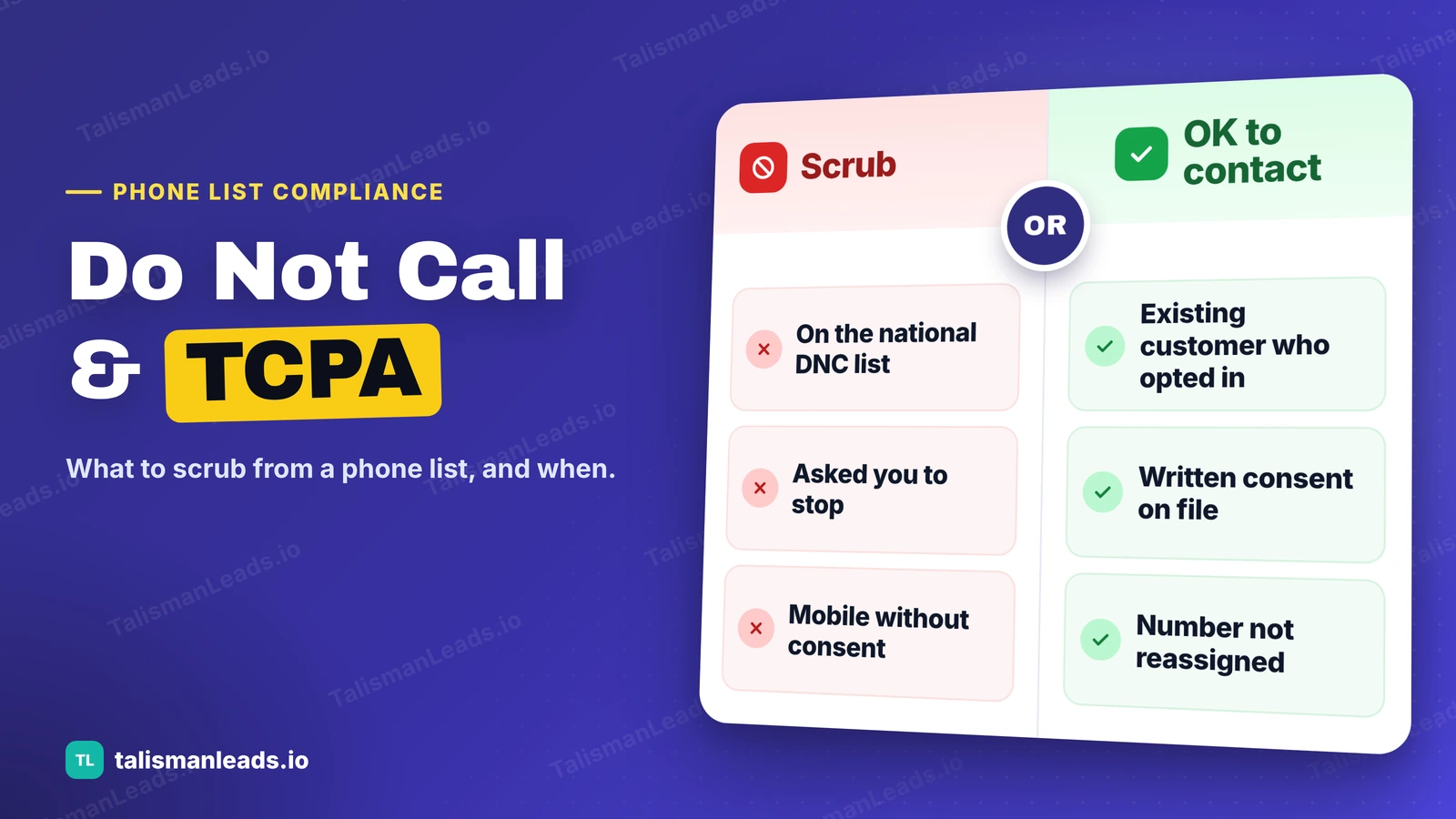
Before a US sales call or marketing text, take four groups off the list: everyone who asked you to stop, numbers on the National Do Not Call Registry (unless the person is a recent customer or gave you written permission), mobile numbers you would reach by autodialler, prerecorded voice or marketing text without the person's prior express written consent, and numbers reassigned to someone new since that consent was given. Scrub against a registry copy no more than 31 days old, contact the rest only between 8 a.m. and 9 p.m. their time, and keep a record of each step.
This guide is for a business calling or texting its own customers and leads. This is general information, not legal advice: the rules below are the federal ones, states add their own, and a lawyer who knows your campaigns should check how they apply to you.
Which calls and texts the rules cover#
Two federal rulebooks apply. The FTC's Telemarketing Sales Rule (16 CFR 310) covers sellers and telemarketers making sales calls. The FCC's rules under the Telephone Consumer Protection Act (47 CFR 64.1200) cover telephone solicitations, autodialled and prerecorded calls, and texts.
Texts are calls. The FCC has treated text messages as calls under the TCPA for years (FCC 15-72), and since March 26, 2024 its Do Not Call rules name "text messages" to wireless numbers in so many words (64.1200(e), added by FCC 23-107).
Sales messages are the target. The FTC says purely informational calls, such as an order update with no sales pitch, are outside its Do Not Call rule, and that a call mixing information with an offer is a sales call (FTC Q&A). Informational texts still need consent when sent by autodialler; the FCC puts it simply: "Commercial texts require written consent; for informational texts, your consent may be oral." Political calls, charity calls and true surveys have their own exemptions, as do most calls to businesses.
The National Do Not Call Registry#
Who checks it. A seller making sales calls, and any telemarketer calling for it, must remove registered numbers. Only sellers, telemarketers and their service providers can download the list, at telemarketing.donotcall.gov.
Every 31 days. The TSR's safe harbour asks you to use a version of the registry obtained "no more than thirty-one (31) days" before the call (16 CFR 310.4(b)(3)(iv)); the FCC's rule says the same (64.1200(c)(2)(i)(D)). A list scrubbed in September is stale by November. Registrations do not expire: the FCC's rule honours them "indefinitely, or until the registration is cancelled".
The fee and the SAN. The first five area codes are free. From October 1, 2026 (fiscal year 2027), each further area code costs $85 a year, and all of them $23,425 (FTC, August 26, 2026). Each seller gets a Subscription Account Number (SAN). A seller that uses a telemarketer still needs "its own subscription and SAN", and a telemarketer may not use one download for several sellers or share the fee (FTC Q&A; 16 CFR 310.8).
The exemptions. A registered number may still get your sales call when:
- You have an established business relationship: a purchase or transaction in the last 18 months, or an inquiry or application in the last 3 months (the TSR counts 540 and 90 days). It ends the moment the person asks you not to call.
- You have their written permission: a signed written agreement, electronic signatures included, that shows they agreed to your calls and gives the number (16 CFR 310.4(b)(1)(iii)(B); 64.1200(c)(2)(ii)).
These exemptions answer the registry question only. An established customer on the registry may get a live sales call from you; an autodialled or prerecorded marketing call or a marketing text to their mobile still needs their prior express written consent (below).
Your own do-not-call list#
Every business that makes telephone solicitations keeps a company-specific do-not-call list. Under the FCC's rule (64.1200(d)) you need:
- A written policy, available on demand, and staff trained on it.
- The request recorded when it is made, and honoured within a reasonable time that "may not exceed ten (10) business days".
- Honoured for 5 years from the request.
The FCC applies these rules to texts to wireless numbers too (64.1200(e)), and the TSR makes the same request binding on sellers, even for an existing customer (16 CFR 310.4(b)(1)(iii)(A)). Treat "stop calling me" on the phone, STOP by text and an email asking to be removed as the same thing: one list, checked before every campaign.
Consent for autodialled, prerecorded and text marketing#
Prior express written consent. A marketing call made with an autodialler or an artificial or prerecorded voice to a mobile number needs the called party's prior express written consent (64.1200(a)(2)); so does a prerecorded marketing call to a home landline ((a)(3)). That consent is a signed written agreement, electronic signatures included, that clearly authorises your marketing calls or texts to that number and says agreeing is not a condition of purchase ((f)(9)). How to collect it on a sign-up form is covered in How to Build an SMS and Email List From Scratch.
The FCC's "one-to-one" consent rule of December 2023 never took effect: the Eleventh Circuit vacated it on January 24, 2025, and the FCC removed it from its rules, effective August 29, 2025 (DA 25-621).
Revoking consent. Under the FCC's February 2024 order (FCC 24-24), in force since April 11, 2025 (DA 24-1068), people may revoke consent by any reasonable means; "stop", "quit", "end", "revoke", "opt out", "cancel" or "unsubscribe" in reply to a text always counts; you have at most ten business days to act; and one confirmation text, with no marketing, is allowed. The order's "revoke all" part was postponed twice (DA 25-312, April 7, 2025; DA 26-12, January 6, 2026) and is replaced by the newer order below.
What changes on November 25, 2026. FCC 26-67, adopted September 30, 2026 and published in the Federal Register on October 26, 2026, takes effect on November 25, 2026:
- A caller may name one exclusive way to opt out: a key press or voice option on the call, a reply word to a text, or a website or phone number, disclosed clearly in the call or text.
- An opt-out in reply to a marketing call or text revokes consent to all your future marketing calls and texts. One in reply to an informational message may be treated as covering that kind of message only.
- The ten business days stay. The FCC is asking in the same order whether to shorten them (comments due November 25, 2026).
Quiet hours: 8 a.m. to 9 p.m.#
Telephone solicitations may go out only between 8 a.m. and 9 p.m. at the called person's location (64.1200(c)(1); 16 CFR 310.4(c)), and the FCC applies the rule to marketing texts to mobiles (64.1200(e)). An area code tells you where a number was first issued, not where its owner is today, so a national send is safest in a window that is inside those hours in every time zone you serve.
State lists and stricter state laws#
States add their own lists, hours and registration duties, and some go further than the federal rules. Texas is one example: it keeps a Texas no-call list that telemarketers must honour within 60 days of a number appearing on it (Bus. & Com. Code 304.052), and since September 1, 2025 its telemarketing registration law counts texts as telephone solicitations (302.001(7), as amended by S.B. 140), with an exemption for a business soliciting its own former or current customers under the same name for at least two years (302.058). Check the states where your customers live before a campaign, not after.
The Reassigned Numbers Database and its safe harbour#
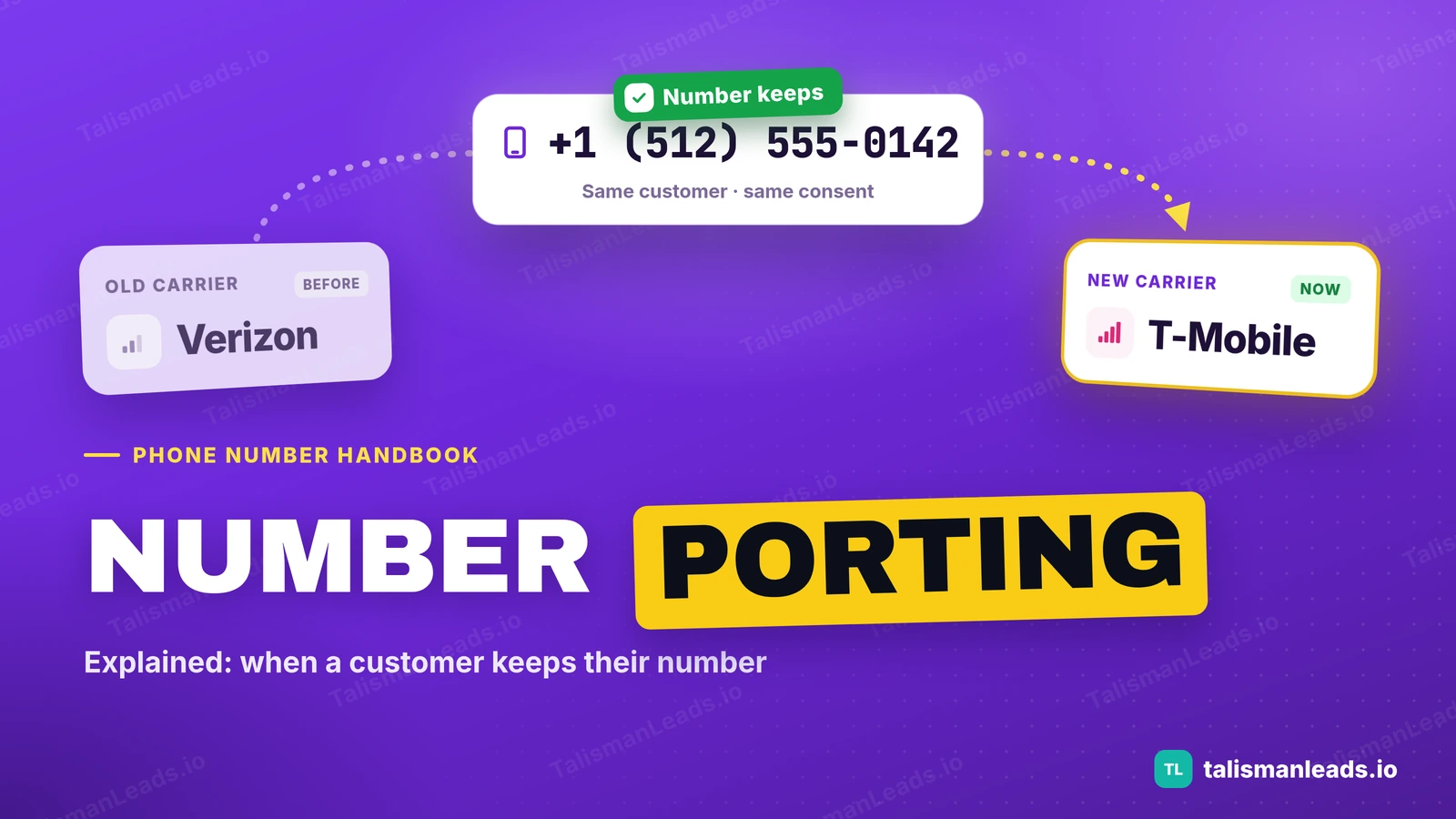
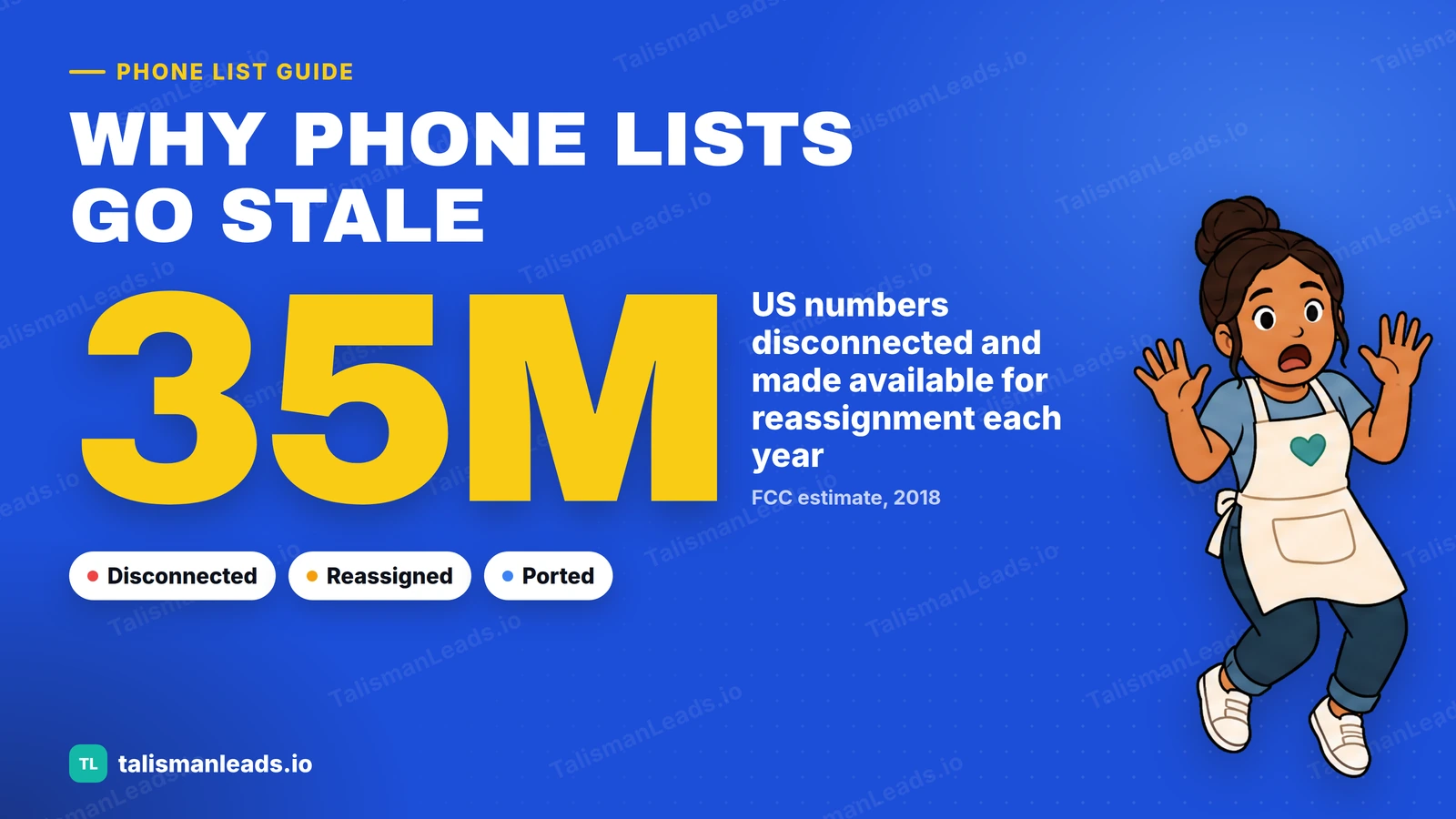
Consent belongs to the person who gave it, not to the number, and US numbers go to new people after a wait of at least 45 days. The FCC's Reassigned Numbers Database, live since November 1, 2021, answers one question: has this number been permanently disconnected since a date you give? Phone companies report disconnections to it every month (64.1200(l)), and you query it at reassigned.us on a paid plan sized by the number of queries.
The safe harbour in 64.1200(m) protects a caller who reaches a reassigned number only if it had valid consent from the earlier holder, queried the most recent data with the number and the date of that consent, got "no", and the "no" was the database's mistake. It covers the consent rules, and the caller carries "the burden of proof and persuasion". Why Phone Lists Go Stale explains how often this happens.
Keep the records#
- Under the TSR, keep for 5 years: the registry version you used, with its date and your SAN; do-not-call requests; consents and written agreements; established-relationship records; and call records (16 CFR 310.5, amended in 2024 from two years).
- For consent, keep the date, the form or page and the exact wording: the Reassigned Numbers Database safe harbour needs that date, and the TCPA puts proof on you.
- For each campaign, keep the scrub date, the database answers and the final list sent.
Mistakes are expensive: the FTC can seek up to $53,088 per TSR violation, and a person can sue under the TCPA for $500 per violation, up to three times that if willful or knowing.
The scrub, in order#
- Remove everyone on your internal do-not-call list and every revoked consent.
- Remove numbers on the registry (a copy under 31 days old) unless an exemption applies.
- For autodialled, prerecorded and text marketing, keep only numbers with written consent on file.
- Query the Reassigned Numbers Database with each number's consent date and drop every "yes".
- Check your state lists and laws, schedule within quiet hours, and save the records.
What TalismanLeads checks, and what it does not#
TalismanLeads does not check numbers against the National Do Not Call Registry, state no-call lists or the Reassigned Numbers Database, and it cannot know who gave you consent. Those answers come from your registry download, your own records and the FCC's database.
What our checks add is the number itself:
- Line type. The rules above turn on whether a number is a mobile, and a text to a landline will not arrive anyway. The Number Carrier Lookup returns each number's line type (mobile, landline or VoIP), carrier and location for $1.20 per 10,000 numbers, and the free Bulk Carrier Lookup does 10,000 a day with no account. For US numbers our lookup reads the published assignments of each thousand-number block, so a landline ported to a mobile can still read "landline". Use "mobile" to route texts; never use "landline" as a reason to skip consent.
- Stale entries. The free Number Cleaner removes invalid numbers and duplicates and writes every number in one format, so your scrubs match. A number that is valid can still have been reassigned: that is the database's job.
Nobody is called or texted while we check. Each file shows its price before anything is charged, failed checks are refunded, and credits never expire. Businesses can apply for a $5, 14-day free trial. The whole preparation routine is in How to Prepare and Validate a Phone List Before a Campaign.
Frequently asked questions#
Do I need to scrub my own customers against the Do Not Call Registry?#
For sales calls, customers who bought in the last 18 months or enquired in the last 3 are exempt, unless they asked you to stop. Autodialled or prerecorded marketing calls and marketing texts to their mobiles still need their written consent.
Does the Do Not Call Registry apply to text messages?#
Yes. The FCC treats texts as calls, and since March 26, 2024 its Do Not Call rules name text messages to wireless numbers explicitly.
How often do I have to scrub against the registry?#
Use a copy obtained no more than 31 days before the call or text. Most businesses download it monthly and scrub before each campaign.
How fast must I honour a STOP or do-not-call request?#
Within ten business days at most, under the FCC's rules, and a do-not-call request then stands for 5 years. Same-day removal is simpler and safer.
Can TalismanLeads check numbers against the Do Not Call list?#
No. TalismanLeads checks a number's validity, line type and carrier. Registry scrubbing is done with your own SAN at telemarketing.donotcall.gov.
Does the Reassigned Numbers Database protect me?#
Only for consent you really had from the earlier holder, if you queried it with the consent date and it wrongly answered "no". It does not replace consent or Do Not Call scrubbing.
Check line types before your next campaign with the free Bulk Carrier Lookup, and move whole files to the Number Carrier Lookup.
Was this helpful?