Number Porting Explained: When a Customer Keeps Their Number
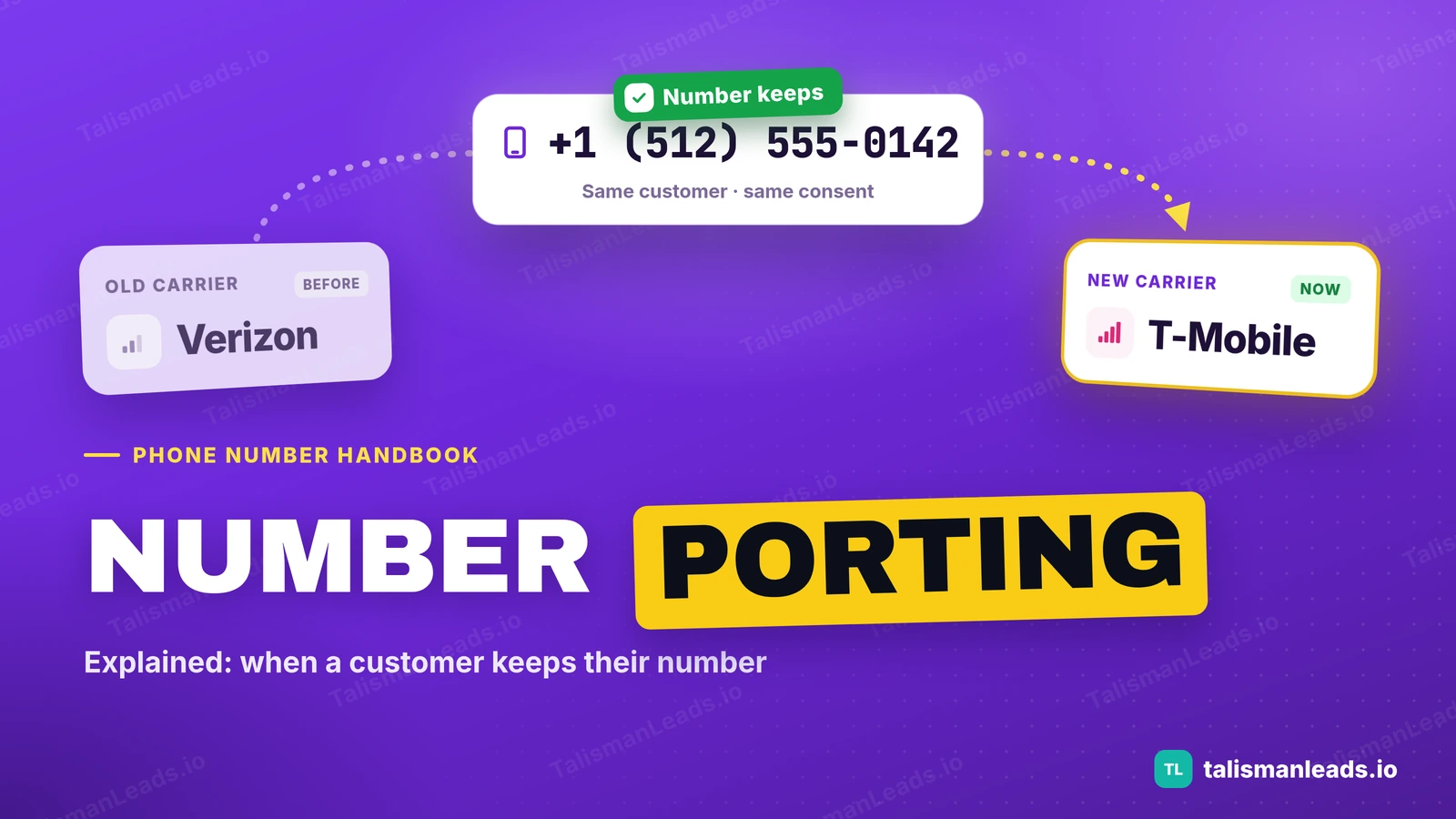
A ported number is a phone number that has moved from one carrier to another while its owner kept it. In the US, FCC rules let people keep their number when they switch providers in the same area, from Verizon to T-Mobile, or from a home landline to a cell phone. For a business, a port changes less than it seems: the number on your list, the person behind it and the consent they gave all stay the same. What changes is the carrier, sometimes the line type, and whether a carrier lookup still shows the right carrier.
This guide is for businesses that text or call their own customers: how porting works, how often it happens, why a lookup can show the old carrier, and what to do about ported numbers on your list.
What number porting is#
Federal rules define number portability as the ability of users to keep "existing telecommunications numbers … when switching from one telecommunications carrier to another", at the same location (47 CFR 52.21). The FCC's consumer guide to porting puts it plainly: if you switch providers and stay in the same geographic area, you can keep your number, and porting can be done "between wireline, IP and wireless providers".
That gives three kinds of port you will meet on a customer list:
- Mobile to mobile. A customer moves from Verizon to T-Mobile, or from AT&T to a smaller wireless brand. The most common kind.
- Landline to mobile. A customer cancels the home phone and moves its number to a cell phone. Landline companies have had to port numbers to wireless carriers since November 24, 2003, in the largest markets first (FCC 03-284).
- To or from VoIP. Internet phone services must port numbers in and out too (47 CFR 52.34).
The customer's old carrier cannot refuse a port, the FCC guide says, "even if you owe money for an outstanding balance or termination fee". What a customer usually cannot do is take a local number to another part of the country, because numbers are issued in blocks tied to a place (see how US numbers are assigned).
How a port works#
The customer starts with the new carrier. The FCC describes a wireless port this way (FCC 23-95): the customer gives the new provider the phone number, the account number, the ZIP code and any passcode; the new provider sends the request through the national numbering administrator; the old provider checks those details ("validating the port"); and the two carriers coordinate the move.
The move is recorded in the national porting database, the Number Portability Administration Center (NPAC), which stores for each ported number a Location Routing Number (LRN) pointing to the switch of the carrier now serving it. Carriers query it to route calls to the right carrier (FCC 97-289), and the FCC notes that the porting administrator "facilitates the routing of telephone calls and text messages on a daily basis" (FCC 15-35).
It is fast. FCC rules require simple ports to be completed within one business day (47 CFR 52.35), and the FCC guide says a move between wireless carriers can work within a few hours, while landline to wireless "may still take a few days".
How often numbers are ported#
Constantly. The FCC's latest numbering report, drawn from the porting administrator's data, counts more than 963 million numbers ported between the start of wireless porting in 2003 and the end of 2024, with 263 million numbers in the porting database at the end of 2024.
In 2024 alone, the FCC's table records about 40.5 million ports. About 22.6 million were mobile to mobile and 11.8 million landline to landline. Overall, the FCC reports, 86.1% of ports have been between providers of the same type of service. By our count from the FCC's 2024 table, about one port in eight changed the type of line, and landline to mobile, the move that matters most to a texting list, was about 670,000 numbers, under 2% of the year's ports.
Why a carrier lookup still shows the original carrier#
A carrier lookup that reads number ranges answers "whose block is this number in?", not "which carrier serves it today?". Carriers receive numbers in blocks, and the public assignment tables record who received each block and what kind of service it is for. A port does not change the block's record; it lives in the NPAC. So for +1 (512) 555-0142, first issued from a Verizon block and since moved to T-Mobile, a range-based lookup shows Verizon. If the number moved from a landline to a cell phone, it may still show landline.
That is exactly how the Number Carrier Lookup on TalismanLeads works. For +1 numbers it reads the public NANPA and Canadian assignment files by area code and exchange, and returns line type, carrier, location and whether the number is valid. It has no porting column and does not detect ports: a ported number shows the carrier that first held its block. The most common mistake we see is treating that carrier column as the current carrier, for example splitting a list by carrier to pick an SMS route or a carrier-specific offer.
It is still the right tool for what it is built for: it catches invalid numbers, toll-free numbers and landline blocks, and since most ports keep the type of line, its line type is right for the great majority of numbers. Step by step: landline or mobile? How to check a US number before you text.
What porting (LRN) data adds#
Porting data, drawn from the national porting database, returns the carrier serving it now, for landlines and VoIP as well as mobiles. Use it when the current carrier is what you are deciding on. It still does not say whether the phone is switched on. For how it compares with a range lookup and an HLR lookup, see carrier lookup vs HLR lookup vs number validation. TalismanLeads does not sell porting data.
What a port changes for a business#
- Your texts and calls still arrive. Routing follows the number; you do not need to do anything.
- The line type may change. A landline that could not take a text may now be a cell phone that can, and a mobile may now be a VoIP line.
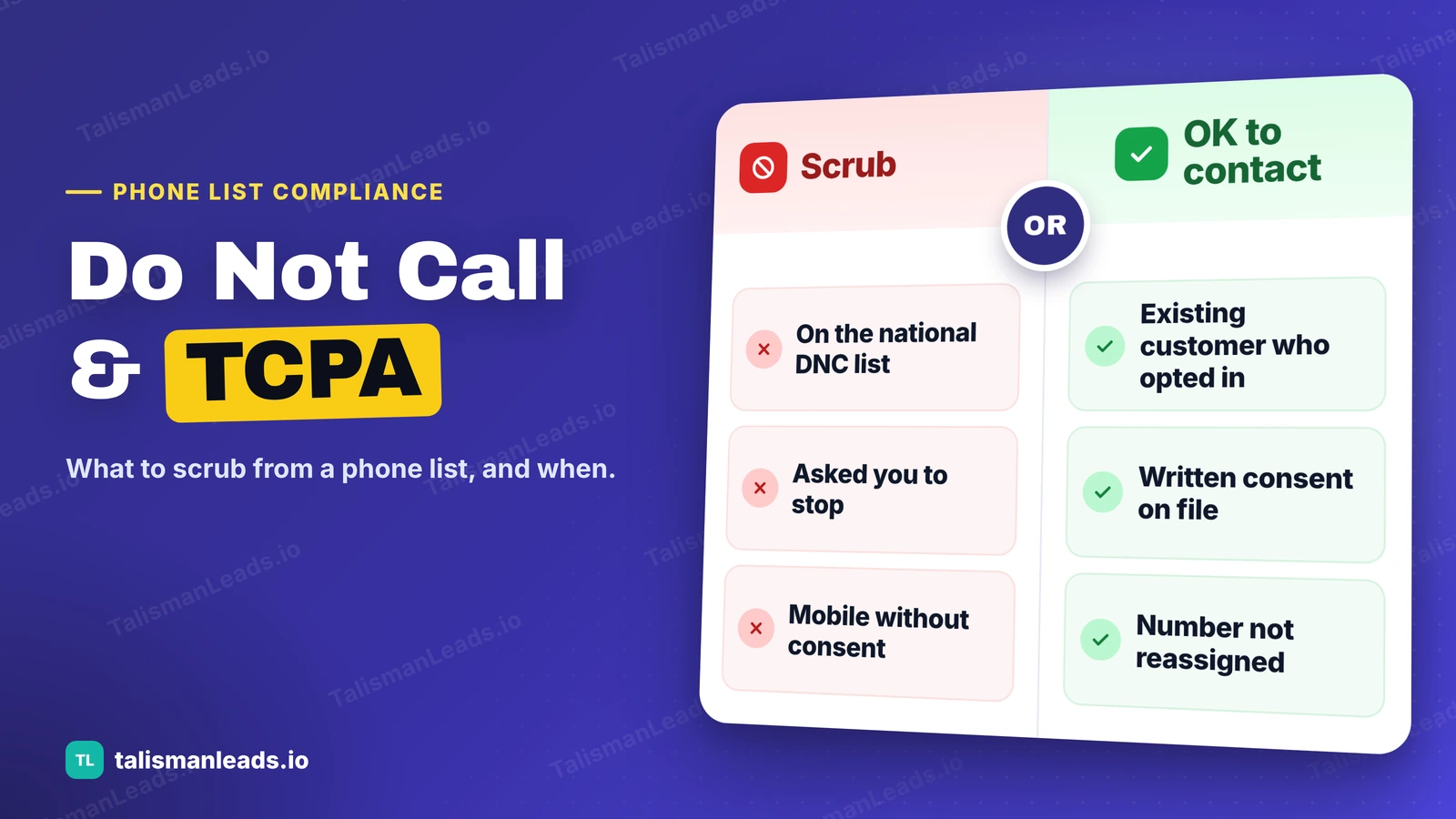
- The consent stays with the person, not the carrier. In its 2015 ruling the FCC clarified that porting a number from landline to wireless "does not revoke prior express consent", as long as that consent already meets the requirements for the same type of call to a wireless number (FCC 15-72). Opt-outs stay too. A 15-day grace period for calls to a number just ported from landline to wireless covers voice calls only, not texts (47 CFR 64.1200). Not legal advice: see Do Not Call and TCPA for phone lists and ask your lawyer.
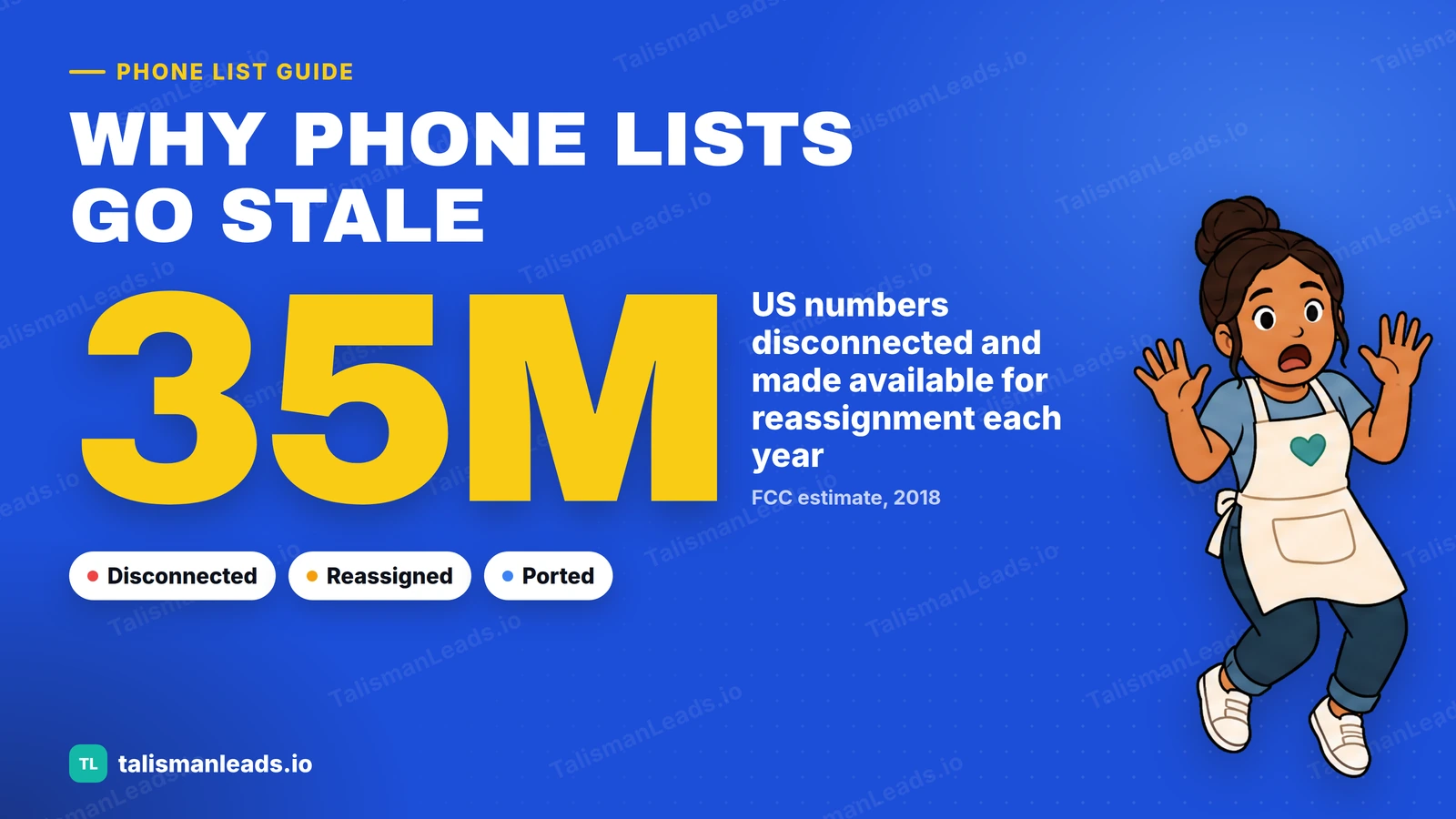
- It is not a reassignment. A ported number still belongs to your customer. A reassigned number was disconnected and given to someone new, which is the real risk on an old list: see why phone lists go stale.
Port-out fraud and text codes#
In port-out fraud, someone posing as your customer has their number moved to a phone the fraudster controls, which lets them "receive text messages and phone calls intended for the victim" (FCC 23-95). New FCC rules require wireless carriers to authenticate customers before a port-out and to notify them of the request, with compliance required by December 18, 2026 (47 CFR 52.37). If you text your customers login or reset codes, do not let a code alone approve a high-value change such as a new payout account; a carrier lookup cannot spot a fraudulent port.
What to do about ported numbers on your list#
- Keep them. A port is not a reason to remove a customer. Their number, and their consent, are still good.
- Re-check line types before a large campaign. A carrier lookup sorts mobiles from landlines for most numbers. If a customer has texted you from a number it calls a landline, trust the conversation: the number may have been ported to a cell phone.
- Do not route or price by the carrier column. If the current carrier matters, use porting (LRN) data from a provider that offers it.
- Keep consent and opt-outs tied to the person and the number, with the date, not to a carrier.
- Check for reassignment separately, with the FCC's Reassigned Numbers Database. No carrier lookup or porting data can tell you a number changed owners.
- Ask customers to confirm their number when they update their profile or order again.
You can run the first check free: the Bulk Carrier Lookup takes 10,000 numbers a day without an account. For whole files, the Number Carrier Lookup costs $1.20 per 10,000 numbers, priced before anything is charged; businesses can test it with a $5, 14-day free trial.
Frequently asked questions#
What is a ported number?#
A phone number that has moved from one carrier to another while its owner kept it, for example from Verizon to T-Mobile, or from a home landline to a cell phone. The number and the person stay the same; the carrier serving it changes.
Can you tell if a phone number has been ported?#
Yes, with porting (LRN) data, which returns the carrier serving the number now. A carrier lookup based on number ranges cannot: it shows the carrier that first held the number's block. The Number Carrier Lookup on TalismanLeads is range-based and does not flag ports.
How long does it take to port a number?#
FCC rules require simple ports to be done within one business day. Between wireless carriers it can take a few hours; landline to wireless may take a few days.
Can a landline number be ported to a cell phone?#
Yes. US landline companies have had to port numbers to wireless carriers since late 2003, as long as the customer stays in the same area. Only about 670,000 numbers made that move in 2024, by our count from the FCC's figures.
Do text messages still reach a ported number?#
Yes. Calls and texts follow the number to its new carrier.
Does consent carry over when a number is ported?#
Consent belongs to the person, not the carrier. The FCC has said porting from landline to wireless does not revoke prior express consent that meets the rules for wireless numbers. Ask your lawyer how this applies to you.
Start with today's free lookups on the Bulk Carrier Lookup, and read its carrier column as the block's carrier, not necessarily today's.
Was this helpful?