Carrier Lookup vs HLR Lookup vs Number Validation
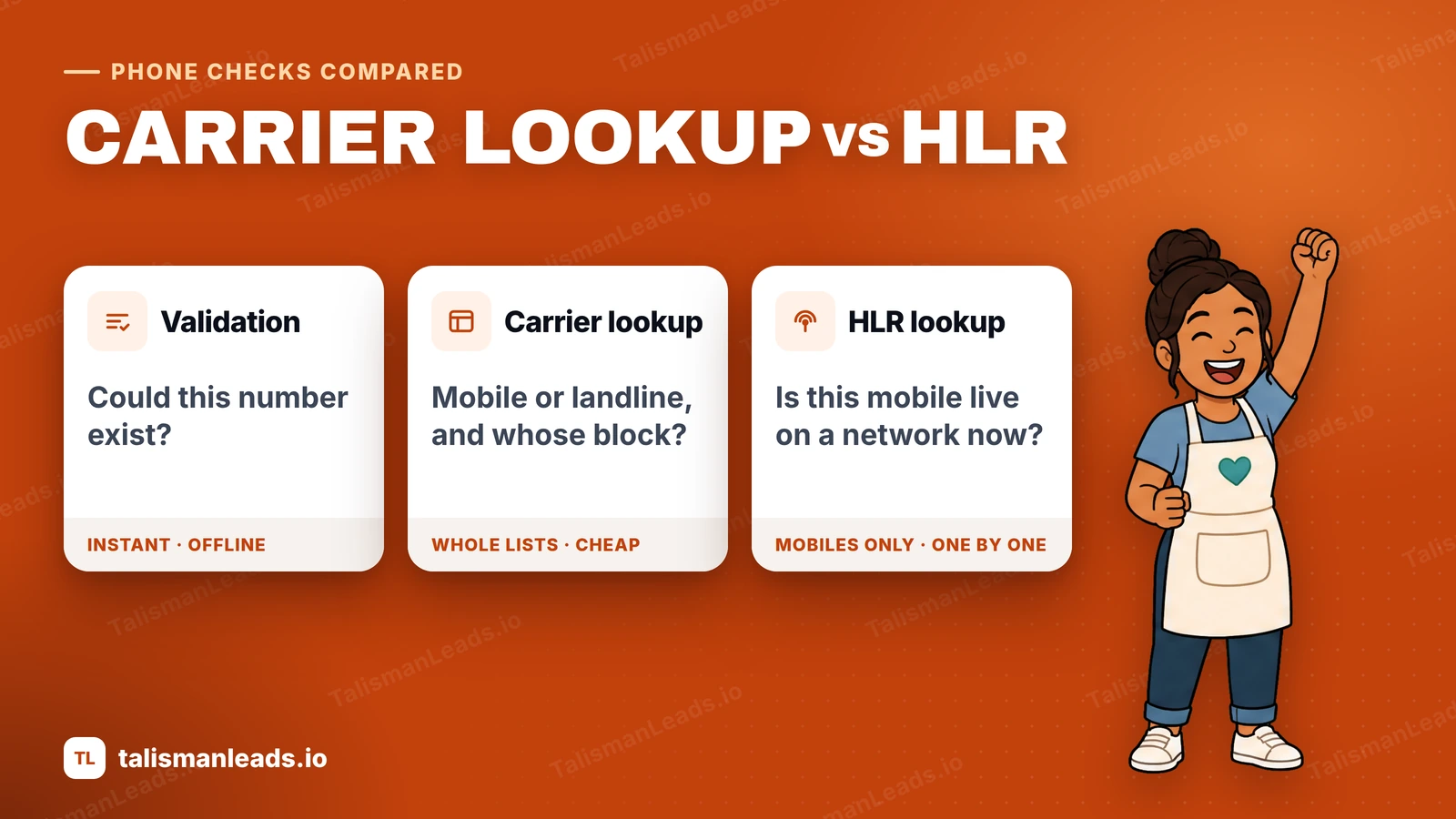
Number validation, carrier lookup and HLR lookup answer three different questions about a phone number. Validation asks whether the number can exist at all. A carrier lookup tells you what kind of line it is and which carrier its number block belongs to. An HLR lookup asks a mobile network whether a mobile number is live on it right now. They differ in what they know, what they cost and how fast they run, so the right one depends on what you need to decide.
This guide explains each check plainly, adds the US piece most comparisons leave out (number porting and LRN data), and helps you pick the right check for cleaning a customer list, a sign-up form or a text campaign.
Three checks, three questions#
- Number validation: "Could this number exist?" It checks the format against the country's numbering plan, offline.
- Carrier lookup: "What kind of line is this, and whose block is it in?" It reads published number-range tables.
- HLR lookup: "Is this mobile number registered on a network right now?" It asks the mobile network's own subscriber database, through a provider.
Number validation: could this number exist?#
Validation checks a number against the rules of its country's numbering plan: the right length, a real area code and exchange, no impossible digits. In the US, +1 (512) 555-0142 is well formed; a number starting with area code 123 is not, because no US area code starts with 1.
It is instant and practically free, so it belongs on every sign-up form: it catches typos before they reach your database. Libraries such as Google's libphonenumber do it offline.
What it cannot do is just as important. The library's own guide says plainly: do not rely on it "to determine whether numbers are currently assigned to a specific user and reachable" (libphonenumber FAQ). And for US numbers it usually cannot tell mobile from landline, because both use the same area codes and exchanges: it reports them as "fixed line or mobile".
Carrier lookup: what kind of line, and whose block?#
A carrier lookup goes one step further. Phone numbers are handed out to carriers in blocks, and published number-range tables record which carrier holds each block and what kind of service the block is for. A carrier lookup reads those tables and returns, for each number:
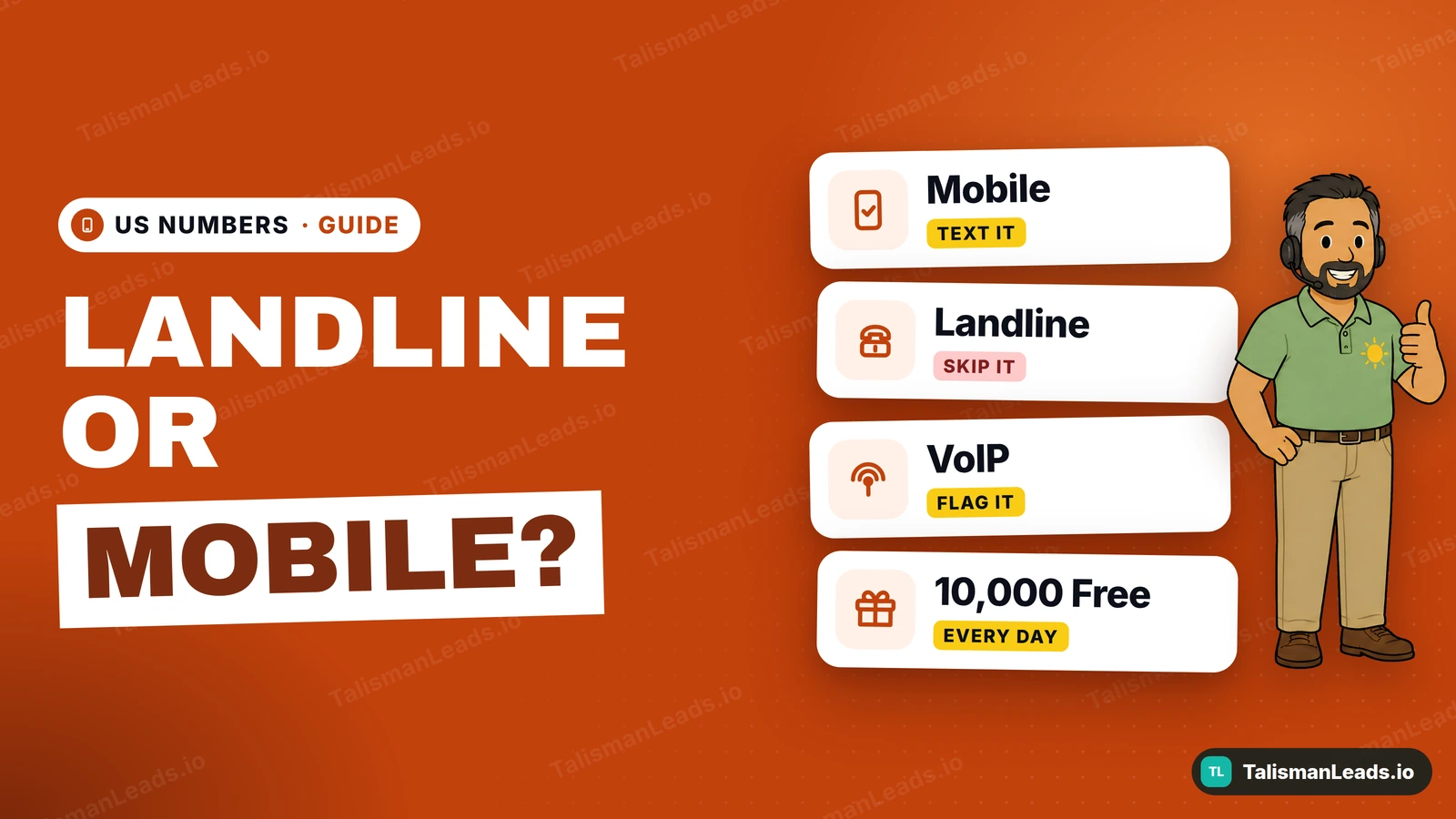
- the line type: mobile, landline, VoIP, toll-free or premium rate
- the carrier that holds the number's block
- the region, and whether the number is valid
Because it reads tables rather than asking a network, it is fast and cheap enough to run on a whole list at once, and nobody on the list is called or texted. That is why it is the usual first step before an SMS campaign: it separates the mobiles from the landlines that cannot take a text.
Its limit is porting. A number keeps its block when the customer moves to another carrier, so a range-based lookup shows the carrier that first held the block, and now and then the block's original line type. It also cannot tell you whether the phone is switched on, or whether the number still belongs to the same person.
HLR lookup: is this mobile live right now?#
The HLR (Home Location Register) is the database inside a mobile network that holds its subscribers' records. In today's networks its role sits within the Home Subscriber Server, which the 3GPP standards describe as "the master database for a given user" (3GPP TS 23.002). An HLR lookup is a query, sent through a provider with access to the mobile signaling network, that asks this database about one mobile number.
Providers describe what it can return: whether the number is a live subscription, which network it is on now (so a ported mobile shows its current carrier), and sometimes whether it is roaming. That makes it the closest thing to "is this number in use?" without calling it.
The trade-offs, again as providers themselves describe them:
- Mobile numbers only. Landlines and VoIP numbers are not in an HLR.
- Coverage and quality vary by country and operator, and some services answer from a cached copy rather than the live network.
- It costs more and runs one number at a time, compared with a range-based lookup.
- It touches subscriber data. Companies that sell porting data argue that HLR access over the signaling network can reveal more about a subscriber than a business needs. Ask any provider what it returns and how it gets it.
TalismanLeads does not offer HLR lookups.
The US piece: porting and LRN data#
In the US, people can keep their number when they change carriers, and sometimes when they move a landline number to a cell phone or a VoIP service. Federal rules define number portability as the ability to keep "existing telecommunications numbers … when switching from one telecommunications carrier to another" (47 CFR 52.21).
To route calls to a ported number, carriers use a Location Routing Number (LRN): in the FCC's words, "essentially a telephone number that designates the switch that serves the customer's new location". A carrier routing a call to a ported number queries the national Number Portability Administration Center, which returns the LRN (FCC, 2017).
So for a US number there is a fourth kind of data: porting (LRN) data, which tells you the carrier serving a ported number today. It answers "which carrier now?", for landlines and VoIP as well as mobiles, but like a range lookup it does not tell you whether the phone is switched on.
Which check should you use?#
Match the check to the decision you are making:
- A sign-up or checkout form: validate in real time, so typos never get in. Confirm ownership with a code or a link if it matters.
- Cleaning a list before an SMS campaign: a carrier lookup on the whole list, to drop invalid numbers and set landlines aside. It is the cheapest way to remove most of the waste. (Step by step: how to check whether a number is a landline or mobile.)
- Choosing the cheapest SMS route, where the current carrier matters: porting data, from a provider that offers it.
- Deciding whether a mobile number is still in use, number by number: an HLR lookup from a provider that offers it, where it covers the country you need.
- Making sure a number still belongs to your customer before you call or text: none of these can. In the US, the FCC's Reassigned Numbers Database answers whether a number has been disconnected since a date you give it.
How to run a carrier lookup on TalismanLeads#
TalismanLeads runs the range-based kind: the Number Carrier Lookup reads number-range tables and returns line type, carrier, region and validity for every number in a file. It is honest about what that means: a ported number may show the carrier that first held its block, and the result does not prove a number is in use.
- Free, up to 10,000 numbers a day: paste or upload your list in the Bulk Carrier Lookup. No account needed. Filter the results by line type and download them as a CSV.
- Bigger lists: the Number Carrier Lookup costs $1.20 per 10,000 numbers, with no daily limit. Upload a .txt file, one number per line with the country code, one country per file. The exact price shows before anything is charged, and every file is billed as at least 2,000 numbers.
Frequently asked questions#
What is the difference between a carrier lookup and an HLR lookup?#
A carrier lookup reads number-range tables: it tells you the line type and the carrier that holds the number's block, for any kind of number, quickly and cheaply. An HLR lookup asks a mobile network's subscriber database about one mobile number: it can say whether the number is live and which network it is on now.
Is number validation the same as verification?#
The words are used loosely. Validation usually means checking that a number could exist (format and numbering plan). Verification usually means confirming more: that the number is in use, or that a person controls it, for example with a code sent by text.
Does a carrier lookup show the current carrier of a ported number?#
Not reliably. A range-based lookup shows the carrier that first held the number's block. For a ported US number, the current carrier comes from porting (LRN) data or, for a mobile, from an HLR lookup.
Can an HLR lookup check a landline?#
No. The HLR holds mobile subscribers. Landlines and VoIP numbers are not in it, so use a carrier lookup to find them and porting data for their current carrier.
Does any of these checks contact the number?#
No. Validation and carrier lookups read rules and tables, and an HLR lookup queries the network's database. None of them calls or texts the number.
Which check is best for cleaning a list before texting?#
A carrier lookup on the whole list. It removes invalid numbers and sets aside landlines and toll-free numbers, at a fraction of the cost of checking every number one by one.
Start with today's free lookups in the Bulk Carrier Lookup and see what your list is made of.
Was this helpful?