How to Detect Fake Sign-Ups With Phone and Email Checks
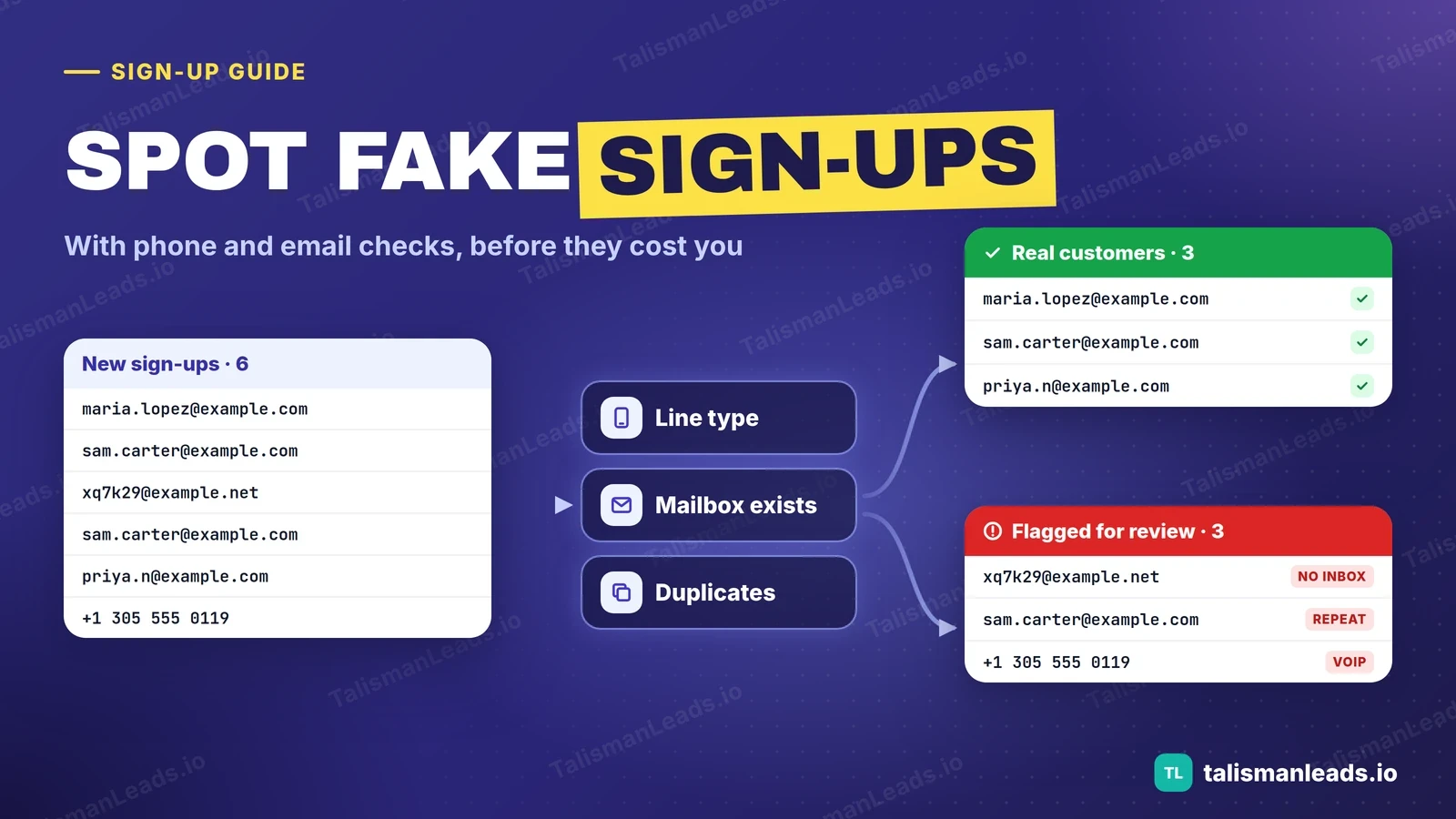
To detect fake sign-ups, look at what each new account gives you: an email address whose mailbox does not exist, a phone number that is invalid or a throwaway VoIP line, the same person behind several accounts, and a burst of sign-ups from one source. Stop the obvious bots at the form, check new sign-ups in batches before you hand out a free trial, a referral bonus or a coupon, and send the doubtful ones to review rather than banning them on one signal.
This guide is for businesses that want to keep their own sign-up list clean. It covers the signals that give a fake account away, what to do at the form, how to check sign-ups in bulk, and how to avoid blocking real customers.
What fake sign-ups cost you#
Creating accounts in bulk to misuse them is common enough that OWASP lists it as its own automated threat, OAT-019 Account Creation. The scale can be huge: in 2023 Microsoft said one criminal group had created about 750 million fraudulent Microsoft accounts to sell.
For an ordinary business the damage is closer to home:
Free trials, referral bonuses and coupons claimed again and again by one person with many accounts.
SMS pumping. Bots type phone numbers into a sign-up or login form that sends a code by text, so that someone along the chain is paid for every message you send. You pay for thousands of texts that verify nothing.
A polluted customer list. Fake addresses bounce, hurt your email reputation, and skew every figure built on sign-ups.
The signals that give a fake sign-up away#
No single signal proves an account is fake. Each one raises or lowers the odds, and several together tell a clear story.
The email address#
The mailbox does not exist. A typed-in address that cannot receive mail is the clearest sign. It may be a typo by a real customer, so ask for a corrected address rather than treating it as fraud.
A disposable domain. Temporary inbox services hand out addresses that last minutes, long enough to receive one code. Spotting them relies on lists of known disposable domains, such as the open-source list on GitHub, which is useful but always a step behind new domains.
Variations of one address. Gmail ignores dots in the name (Google), so j.doe@gmail.com and jdoe@gmail.com reach the same inbox, and many providers also deliver name+anything@ to the same person. Normalize addresses before you look for duplicates.
Not a red flag: privacy relays. Apple's Hide My Email gives each site a random address that forwards to the customer's real inbox. These belong to real, privacy-minded people.
The phone number#
Invalid numbers that cannot exist in their country's numbering plan.
The wrong kind of line. A landline, toll-free or premium-rate number in a field that is meant for a mobile phone is worth a second look.
VoIP numbers. The FCC distinguishes "fixed" VoIP, tied to an address like a cable company's home phone, from "non-fixed" VoIP, "capable of being used from more than one location" (47 CFR 9.11). Non-fixed numbers can be created online in minutes, which makes them a favorite for multi-accounting. Many real customers use them too, so treat VoIP as a reason to look closer, never as proof.
Repeats and patterns#
The same phone number, or variations of the same email, on several accounts.
Many sign-ups in a short time from one IP address, one device or one email domain.
Accounts that claim the trial, bonus or coupon straight away and then never come back.
Stop the obvious bots at the form#
Some protection has to work in real time, while the form is being filled in:
Rate limits per IP address, device and email domain, so one source cannot create hundreds of accounts in an hour.
A bot challenge such as a CAPTCHA or an invisible check. Use it, but do not rely on it alone: CAPTCHAs are solved by software and paid human farms, and the W3C notes that they shut out many disabled users. Show a challenge when something looks wrong rather than to everyone.
Email confirmation. Activate the account, or the reward, only after the customer clicks a link or enters a code sent to the address. Accounts that never confirm are a signal in themselves.
Protect your text-message codes from SMS pumping. Send codes only to countries you serve and only to mobile numbers, limit how many codes one number or IP can request, and watch for spikes of texts with no completed verifications.
Do not treat a text code as proof of identity. NIST classes verification over the phone network as a restricted method: it shows that someone controls a number at that moment, not who they are.
Check new sign-ups in batches before you pay out#
The deeper checks do not need to block the form. Run them on each day's new accounts, or on everyone who is about to receive a trial extension, a referral payout or a large coupon. On TalismanLeads these run on a whole list at once: upload a file, see the price, and download the results a few minutes later. Nobody on the list is called, texted or emailed.
Remove duplicates and invalid entries, free. With a free account, the Email Cleaner and the Number Cleaner (in Free Tools) remove invalid addresses and numbers and exact repeats from up to 200,000 lines at a time, and show what was removed and why.
Check the phone line types. The Number Carrier Lookup labels each number mobile, landline, VoIP, toll-free or premium rate, with its carrier and location, for $1.20 per 10,000 numbers, or free for 10,000 a day with the Bulk Carrier Lookup. It reads numbering-plan data, so it reports VoIP as one type and a ported number may show its original carrier.
Check that the mailboxes exist. The Email Deliverability Checker confirms whether each mailbox exists and can receive mail at Gmail, Yahoo, Outlook, iCloud, Yandex and Mail.ru, for $9.00 per 10,000. Addresses at other domains are left out and not charged.
Optionally, check that the number is in everyday use. A number registered on WhatsApp ($0.69 per 10,000) is usually one a real person uses. Absence proves nothing, so use it only to raise or lower a score.
Every file is billed as at least 2,000 entries, so these checks suit a daily or weekly batch rather than one sign-up at a time. Businesses can try them on their own sign-ups with a $5, 14-day free trial.
Review, don't auto-ban#
A simple score keeps decisions fair and explainable. For example, give each new account a point for every warning sign: a mailbox that does not exist, a disposable domain, a VoIP or non-mobile number, a duplicate of another account, a burst from the same source. Let low scores through, hold the reward on medium scores until the customer confirms an email or adds a payment method, and review high scores by hand.
Keep these rules in mind:
Never block on one signal. Real customers use Google Voice, Hide My Email, shared office networks and VPNs.
Give a way back. A customer flagged by mistake should be able to verify another way and get the account back.
Collect only what you need, and keep it only as long as you need it. That is the FTC's advice to businesses in Start with Security.
Keep watching after sign-up. An account that claims a reward and goes silent says more than any single check at the door.
Frequently asked questions#
How can you tell if a sign-up is fake?#
Look for several warning signs together: an email whose mailbox does not exist or comes from a disposable domain, an invalid or VoIP phone number, the same person behind several accounts, and many sign-ups from one source in a short time. One sign alone is not enough.
Should I block disposable email addresses?#
Blocking known disposable domains at the form is reasonable, but lists miss new domains, so combine it with email confirmation. Do not block privacy relays like Apple's Hide My Email: they belong to real customers.
Is a VoIP number a red flag?#
It is a reason to look closer, not proof. Non-fixed VoIP numbers can be created online in minutes, which suits fake accounts, but many real customers use them. Weigh it together with other signals.
Does phone verification stop fake accounts?#
It raises the cost for fakers but does not stop them: online numbers and SIM farms get past it, and it can expose you to SMS pumping. It proves control of a number at one moment, not identity.
What is SMS pumping?#
Bots enter phone numbers into a form that sends text codes, so that a party along the delivery chain earns money from every message you pay for. Limit codes to mobile numbers in the countries you serve, rate-limit requests, and watch for texts that never lead to a completed verification.
Does CAPTCHA stop fake sign-ups?#
It slows simple bots, but software and human solving farms defeat it, and it can shut out disabled users. Use it alongside rate limits, email confirmation and checks on the account details.
How do I stop free trial and referral abuse?#
Hold the reward until the account is confirmed, check new accounts for duplicate emails and phone numbers before paying out, and look closer at accounts that score high on warning signs.
Start by running today's new sign-ups through the free Bulk Carrier Lookup and see how many numbers are not what they claim to be.
Was this helpful?