Email Opt-In and Unsubscribe Rules: CAN-SPAM, GDPR and Soft Opt-In
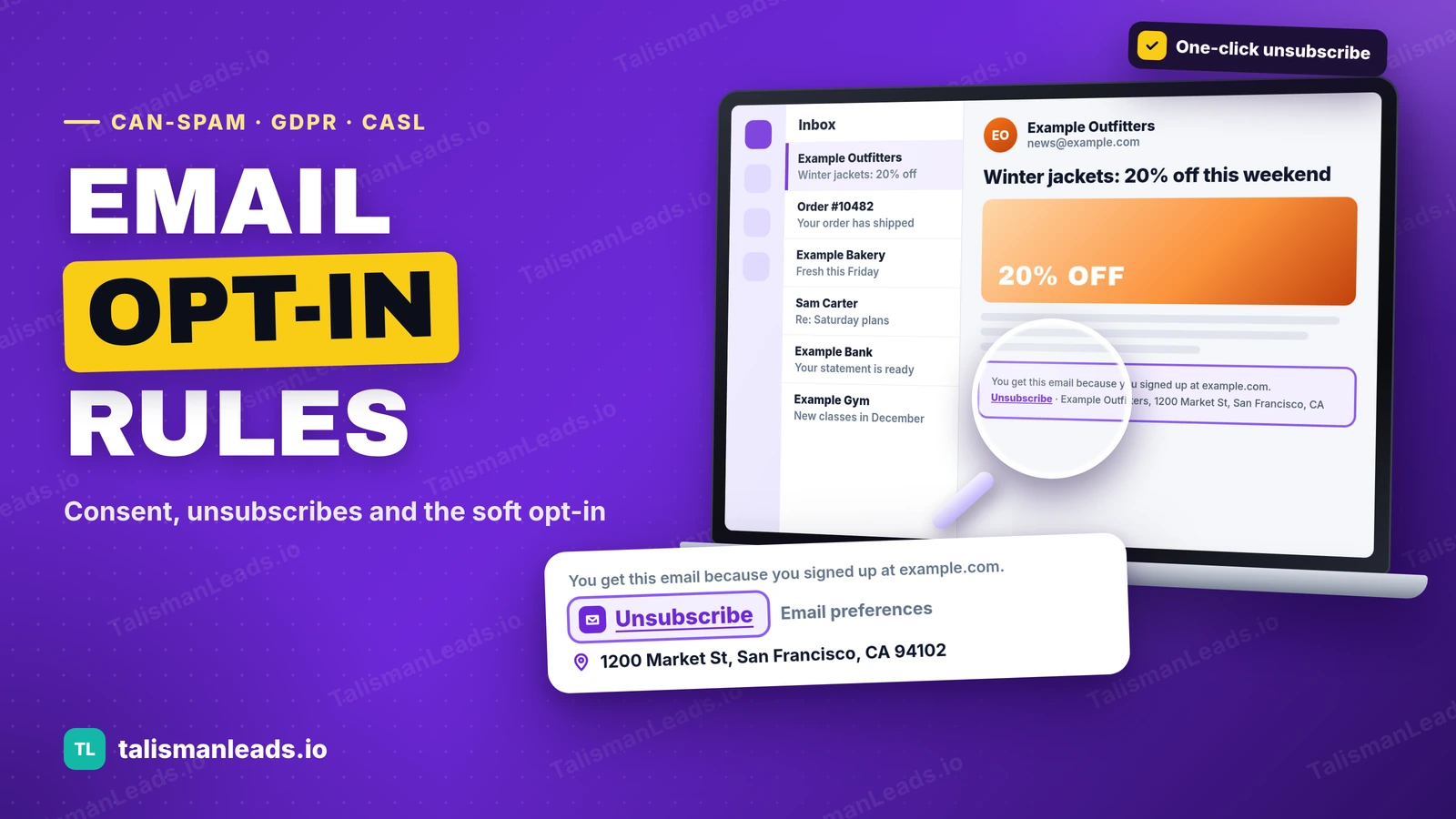
In the US you may send a commercial email without asking first, but CAN-SPAM sets what every message must contain and gives you 10 business days to honor an opt-out. Canada, the EU and the UK work the other way round: you need consent before you send, with a narrow exception for your own customers (implied consent in Canada, the "soft opt-in" in Europe). On top of the law, Gmail and Yahoo require bulk senders to offer one-click unsubscribe. Every rule below was read on the regulators' and providers' own pages on November 23, 2026. This is general information, not legal advice.
United States: CAN-SPAM lets you send first, then sets the rules#
The FTC's CAN-SPAM compliance guide treats the law as an opt-out law: it gives recipients "the right to have you stop emailing them". It covers every commercial message, not only bulk mail, judged by its "primary purpose". A receipt, a shipping notice or a security alert is transactional and exempt from most of the Act, though its routing information must still be accurate.
The guide lists eight points for commercial email:
- Honest headers. The From, To and routing details must identify who sent the message.
- Honest subject lines that reflect what the email contains.
- Say it is an ad, clearly and conspicuously.
- Your postal address: a street address, a PO box registered with USPS, or a private mailbox registered with a commercial mail receiving agency.
- A clear way to opt out of all your marketing email.
- Subscribers and members can opt out too, even if they signed up.
- Honor opt-outs within 10 business days. The opt-out must keep working for at least 30 days after you send. You may not charge a fee, ask for anything beyond an email address, or require more than a reply or a visit to one web page. Once someone opts out, you may not sell or transfer their address.
- You are responsible for what others send for you. Both the company whose product is promoted and the one that sent the email can be held liable.
Each email in violation can cost up to $53,088. The FTC's 2026 notice keeps its penalty amounts at the 2025 levels.
Canada: CASL asks for consent first#
Canada's Anti-Spam Legislation (CASL) forbids sending a commercial electronic message unless the recipient has consented, "whether the consent is express or implied" (section 6).
- Express consent. When you ask, you must say what the consent is for and who is asking. The CRTC's regulations add a mailing address plus a phone number, email or web address, and a statement that consent can be withdrawn.
- Implied consent. It covers an existing business relationship: a purchase or lease within the past two years, or an inquiry within the past six months. It also covers an address the person published, or gave you, when your message is relevant to their work. Implied consent runs out, so record the dates.
- In every message: who sent it and for whom, contact details that work for 60 days, and an unsubscribe that is processed within 10 business days.
The sender has to prove consent (section 13), and the CRTC's advisory on consent records says that burden always stays with the sender. Penalties reach $1 million per violation for an individual and $10 million for a business (section 20).
EU and UK: consent, or the soft opt-in for your own customers#
The EU's ePrivacy Directive (Article 13) allows marketing email to individuals only with their prior consent. Consent then has to meet the GDPR standard: "freely given, specific, informed and unambiguous", given by a clear action. Pre-ticked boxes, silence and inactivity do not count. You must be able to show the consent later, and withdrawing it must be as easy as giving it. The EDPB's consent guidelines add that people should be able to choose each purpose separately rather than accept a bundle.
The soft opt-in is the exception for existing customers. You may email a customer about your own similar products when all three of these hold:
- you got their address in the context of a sale, or in the UK, negotiations for one;
- the email markets your own similar products or services;
- they were given a free, easy way to refuse when you collected the address, and in every message since.
The UK's PECR regulation 22 has the same three conditions. The ICO's email marketing guidance says it does not cover prospects or bought-in lists. Two UK changes from the Data (Use and Access) Act 2025 took effect on February 5, 2026: charities got a soft opt-in of their own, and PECR fines rose to £17.5 million or 4% of global turnover (ICO statement). The ICO marks its email page as under review for these changes.
Business addresses are treated differently. In the UK you may email a company, an LLP or a government body without consent, but you must still identify yourself and offer an opt-out. Sole traders and some partnerships count as individuals. Named staff addresses (firstname.lastname@) can still fall under data protection law. In the EU, Article 13's consent rule protects individuals and leaves business addresses to each country's law.
An objection ends it. Under GDPR Article 21, anyone may object to direct marketing at any time, and their data may then no longer be used for it. Unlike the US and Canada, the law sets no grace period of days.
Double opt-in: not required, worth doing#
No law above requires double opt-in, where a sign-up only joins the list after clicking a confirmation link. The mailbox providers ask for it in their own words: Google tells senders to "confirm each recipient's email address before subscribing them" (sender guidelines), and Yahoo to send an email "asking them to click to confirm their opt-in". The confirming click is also your strongest proof of consent under the GDPR and CASL. How to set up the sign-up form and the confirmation is covered in How to Build an SMS and Email List From Scratch.
Gmail and Yahoo: one-click unsubscribe#
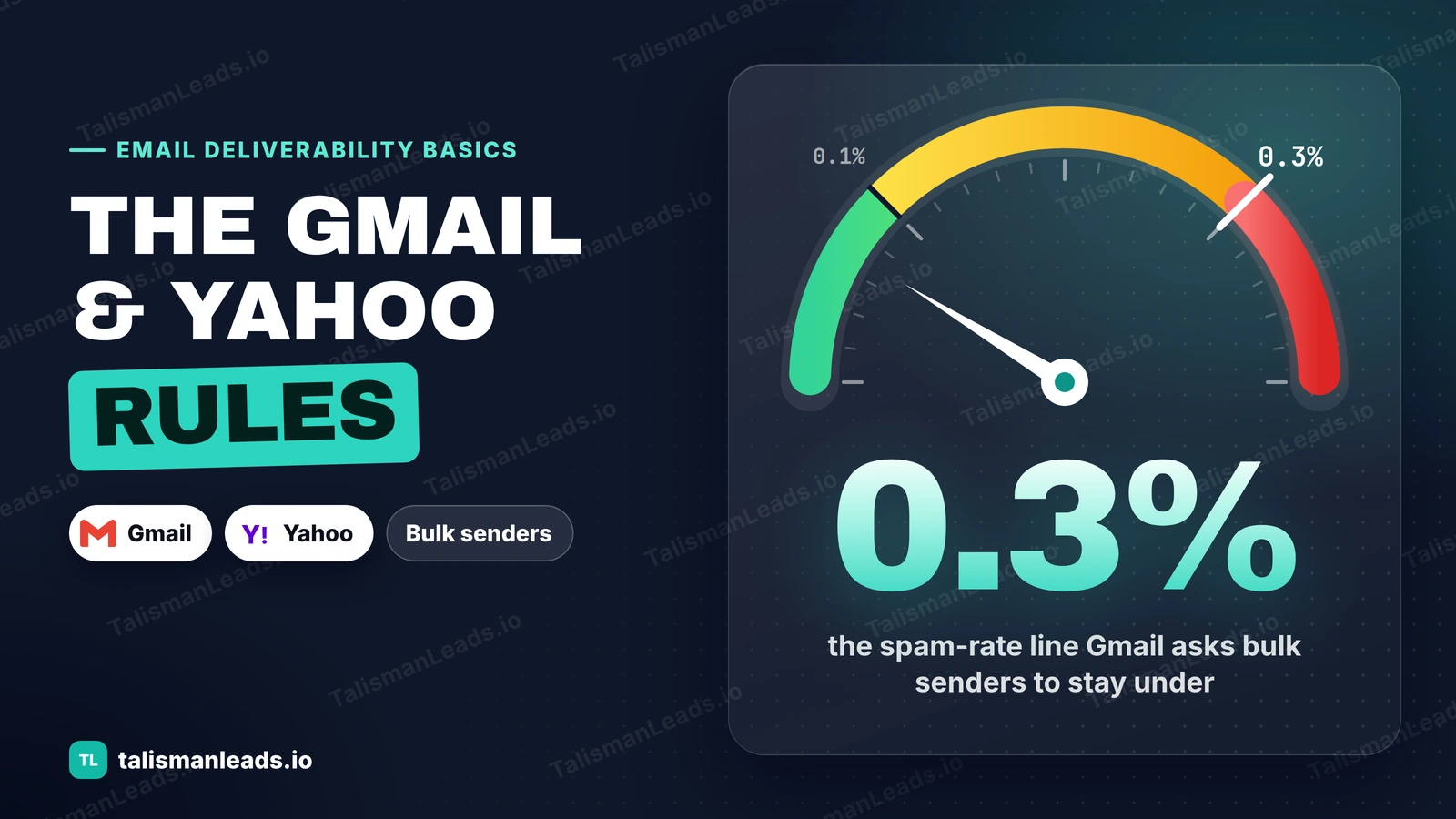
Since 2024, bulk senders (close to 5,000 or more messages a day to personal Gmail accounts, by Google's count) must support one-click unsubscribe on marketing and subscribed messages. They also need a clearly visible unsubscribe link in the body. One-click works through two headers defined in RFC 8058, List-Unsubscribe with an https address and List-Unsubscribe-Post: List-Unsubscribe=One-Click, both signed with DKIM. Google's FAQ says a mailto link in the body does not meet the requirement, excludes transactional mail, and recommends acting on unsubscribes within 48 hours. Yahoo asks for two days. Both are far tighter than the 10 business days the law allows. The full sender rules, from authentication to the 0.3% complaint line, are in Email Deliverability Basics: Bounces, Reputation and the Gmail and Yahoo Rules.
How we built unsubscribe into our own emails#
TalismanLeads sends its own campaign emails. This is how their unsubscribe works:
- Every email is marked Marketing or Service notice. Only service notices (maintenance, a price change) go out without an unsubscribe link. Anything promotional counts as marketing.
- Each marketing email carries its own unsubscribe link and the postal address in the footer, plus the one-click headers.
- Opening the link changes nothing. Mail security scanners open links in incoming mail, so our page asks for a click before it unsubscribes anyone. A one-click request from Gmail or Yahoo is honored at once.
- The opt-out belongs to the address, not the account. If the same person signs up again with that address, they stay unsubscribed. The list is checked again just before each email goes, and a spam complaint unsubscribes the address too.
- Links never expire, well beyond CAN-SPAM's 30 days and CASL's 60.
The records to keep#
When someone asks why an address got your email, these answer it:
- Who and when: the address, the date and time with time zone, and the confirmation click if you use double opt-in.
- Where and what they saw: the form, page or checkout, and the exact wording shown, with its version.
- What they agreed to: each list or message type, kept separate.
- For the soft opt-in or implied consent: the purchase or inquiry date, and proof the opt-out was offered.
- Opt-outs: the date, how the request arrived, and what you did. CASL's advisory lists unsubscribe requests among the records to keep.
- A suppression list of everyone who left, so an old export never brings them back.
Checking an address is not consent#
A mailbox check tells you whether an address can receive mail, not whether its owner agreed to hear from you. Use it on addresses you may already email, to keep bounces down. The Email Deliverability Checker checks Gmail, Yahoo, Outlook, iCloud, Yandex and Mail.ru mailboxes without sending anything, for $9.00 per 10,000 addresses. You see the exact price before you confirm, and a check that cannot be completed is refunded. The free Email Cleaner removes malformed addresses and duplicates first. For the full routine, see How to Clean an Email List Before Your Next Campaign.
Frequently asked questions#
Do I need permission to send marketing emails in the US?#
Not under CAN-SPAM. You can email first, but every message must meet the FTC's requirements, including a postal address and a working opt-out honored within 10 business days. Gmail and Yahoo still expect recipients to have opted in.
What is the soft opt-in?#
The EU and UK exception that lets you email your own customers about your own similar products without separate consent. You must have got the address during a sale or talks about one, and offered a free way to refuse then and in every message.
How fast must I process an unsubscribe?#
Within 10 business days under CAN-SPAM and CASL. Yahoo asks for two days and Google recommends 48 hours, so the same day is safest. In the EU and UK, an objection to marketing takes effect with no grace period.
Is double opt-in required?#
No law here requires it. Google and Yahoo both ask senders to confirm addresses, and the confirmation click is your best proof of consent.
Do transactional emails need an unsubscribe link?#
No. CAN-SPAM exempts them from most of its rules, and Google excludes them from one-click unsubscribe. Keep promotion out of them, or they count as marketing.
Can I email business addresses without consent?#
In the US, yes. In the UK, yes for companies, but not sole traders or some partnerships. In Canada, only an address published or given to you, about their work. In the EU, it depends on the country.
Before your next send to the customers who opted in, check that their mailboxes still exist with the Email Deliverability Checker.
Was this helpful?