iMessage vs RCS vs SMS: What Your Customers Can Receive
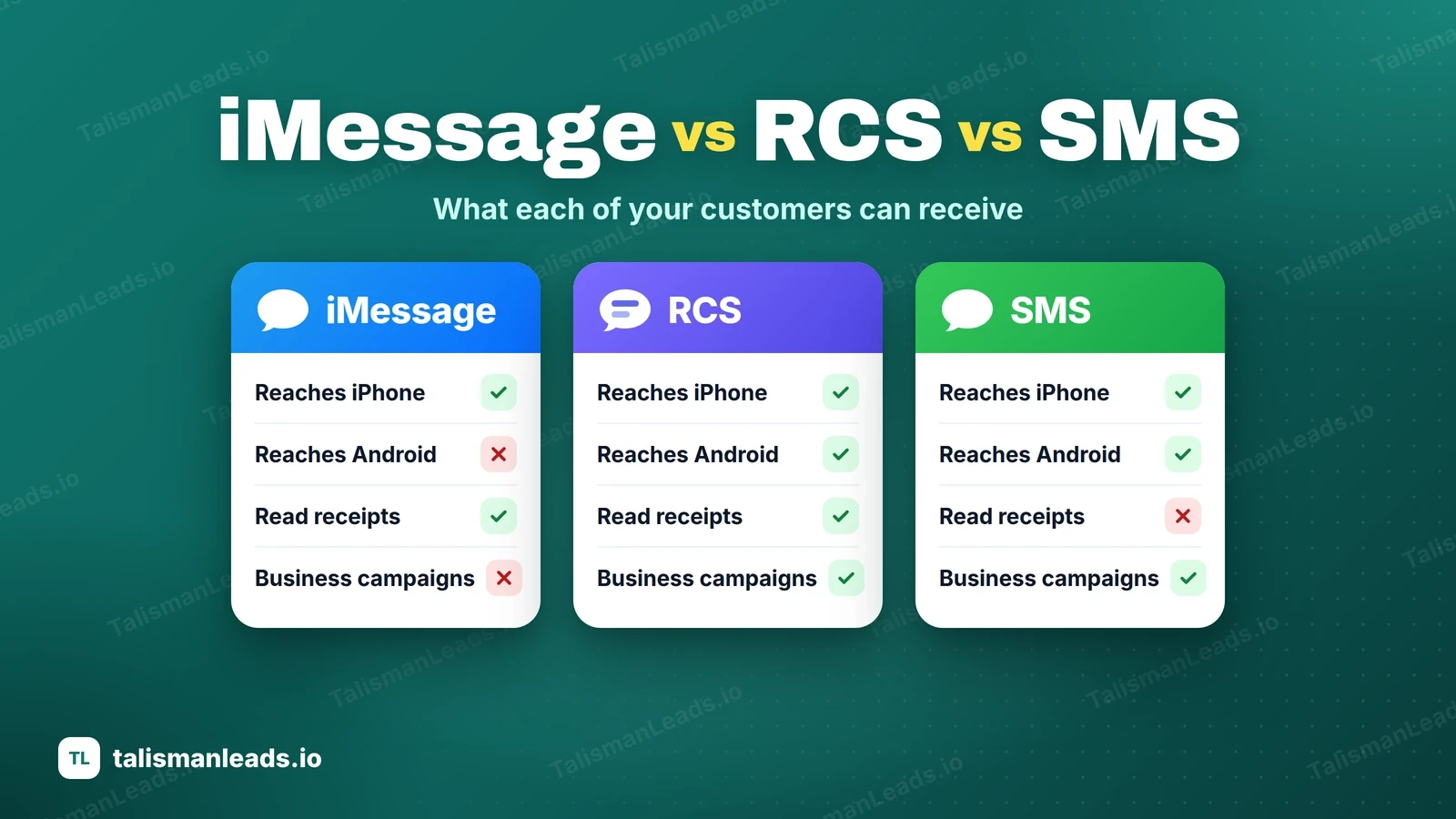
iMessage, RCS and SMS are the three ways a text reaches a phone in the US. SMS reaches every mobile phone. RCS adds photos, buttons and read receipts where the phone and the carrier support it, on Android and, since iOS 18, on iPhone. iMessage runs only between Apple devices, and a business cannot use it to start a conversation. For a business, that means: send RCS to the customers who can get it, SMS to everyone else, and check your list first so you know which is which.
This guide explains how a phone decides which one it gets, what a business can actually send on each, and how to find out what each customer on your list can receive.
The three channels in one minute#
SMS is the original text message: up to 160 characters per segment, with no read receipts and no typing dots. It works on every mobile phone with a text plan, with no app and no data needed. Its picture version is MMS.
RCS (Rich Communication Services) is the modern replacement, built into Google Messages on Android and into the Messages app on iPhone since iOS 18. It carries high-quality photos, read receipts, typing indicators and, for businesses, branded messages with buttons and cards. It needs a capable phone and a carrier that supports it.
iMessage is Apple's own service between Apple devices: the blue bubbles. It has rich features too, but it is closed to everyone outside Apple's devices, and businesses can only reply in conversations customers start.
How an iPhone picks blue or green#
On an iPhone, the sender does not choose the channel. As Apple explains, Messages uses:
iMessage (blue bubble) when the other person's number is registered with iMessage.
RCS (green bubble) when it is not, but both phones and both carriers support RCS. On iPhone this needs iOS 18 or later and a carrier that supports RCS on iPhone (Apple).
SMS or MMS (green bubble) for everything else.
So a green bubble does not tell you whether a message went as RCS or SMS. And the same customer can move between them when they change phone, carrier or settings.
What a business can send on each channel#
SMS: the channel that reaches everyone#
Every US mobile number can receive SMS, which is why it remains the backbone of business texting. In the US, a business sends from a registered 10-digit number (A2P 10DLC, registered through The Campaign Registry via your messaging provider) or from a verified toll-free number; carriers block unregistered business traffic. Texts are billed per 160-character segment, and a single emoji switches the whole message to a 70-character segment, so long or emoji-heavy texts cost more.
RCS: rich messages where they are supported#
Businesses send RCS through RCS for Business (Google's name for RCS Business Messaging). Before a single message goes out, the brand is verified and the sending "agent" is approved by each carrier (Google); promotional messages may go only to customers who opted in. In return you get your logo and name on the message, photos, suggested-reply buttons, and delivery and read events.
iPhones receive business RCS too, where the carrier supports it: Apple even gives iPhone users a switch to turn RCS business messages on or off (Apple). Messaging providers report that most major US carriers now support it on both iPhone and Android, but support still varies by carrier, so every serious RCS sender keeps SMS as the fallback for numbers that cannot receive RCS.
iMessage: only when the customer starts#
There is no public way for a business to start an iMessage conversation. Apple Messages for Business lets customers message a company from a button on its website, app, Apple Maps or a QR code, through an Apple-approved messaging provider (Apple). The business can follow up in conversations the customer opened, but Apple's guidelines say those messages should not carry promotions unless the customer asked for them. Services that promise "bulk iMessage campaigns" are not an Apple product, and Apple's software license forbids using its services to spam.
Is RCS encrypted now?#
Partly, and only recently. In May 2026 Apple began rolling out end-to-end encrypted RCS in beta between iPhones on iOS 26.5 and Android phones on the latest Google Messages, built on the GSMA's RCS Universal Profile 3.0. It works only when every participant's carrier supports it, and a lock icon shows when a chat is encrypted. SMS is never end-to-end encrypted. Messaging providers report that the new encryption covers person-to-person chats, not business messages. Many articles that rank today still say RCS between iPhone and Android is never encrypted: that stopped being true in 2026.
Which channel will each of your customers get?#
Put your list through four questions, in this order:
Is the number a mobile at all? A landline gets none of the three: move it to calls or email. (See how to check whether a number is a landline or mobile.)
Does the number support RCS? If yes, and you have an RCS sender, send rich messages to that group.
Is it registered with iMessage? That tells you the customer most likely uses an iPhone. Useful for knowing your audience, for example when testing how a message looks, though you still reach them by RCS or SMS.
Everyone else gets SMS, which every mobile can receive.
Apple is estimated to account for more than half of new smartphones sold in the US (Counterpoint Research, Q3 2026: 57% of shipments), so on most US lists the iPhone share is large enough to matter.
How to check your list on TalismanLeads#
Each of these runs on a whole file at once. No message is sent to anyone, so nobody sees a bubble, a call or a read receipt.
RCS Number Checker, $3.00 per 10,000 numbers: marks each number RCS supported or SMS only. Load the first group into your RCS sender and the second into your SMS tool.
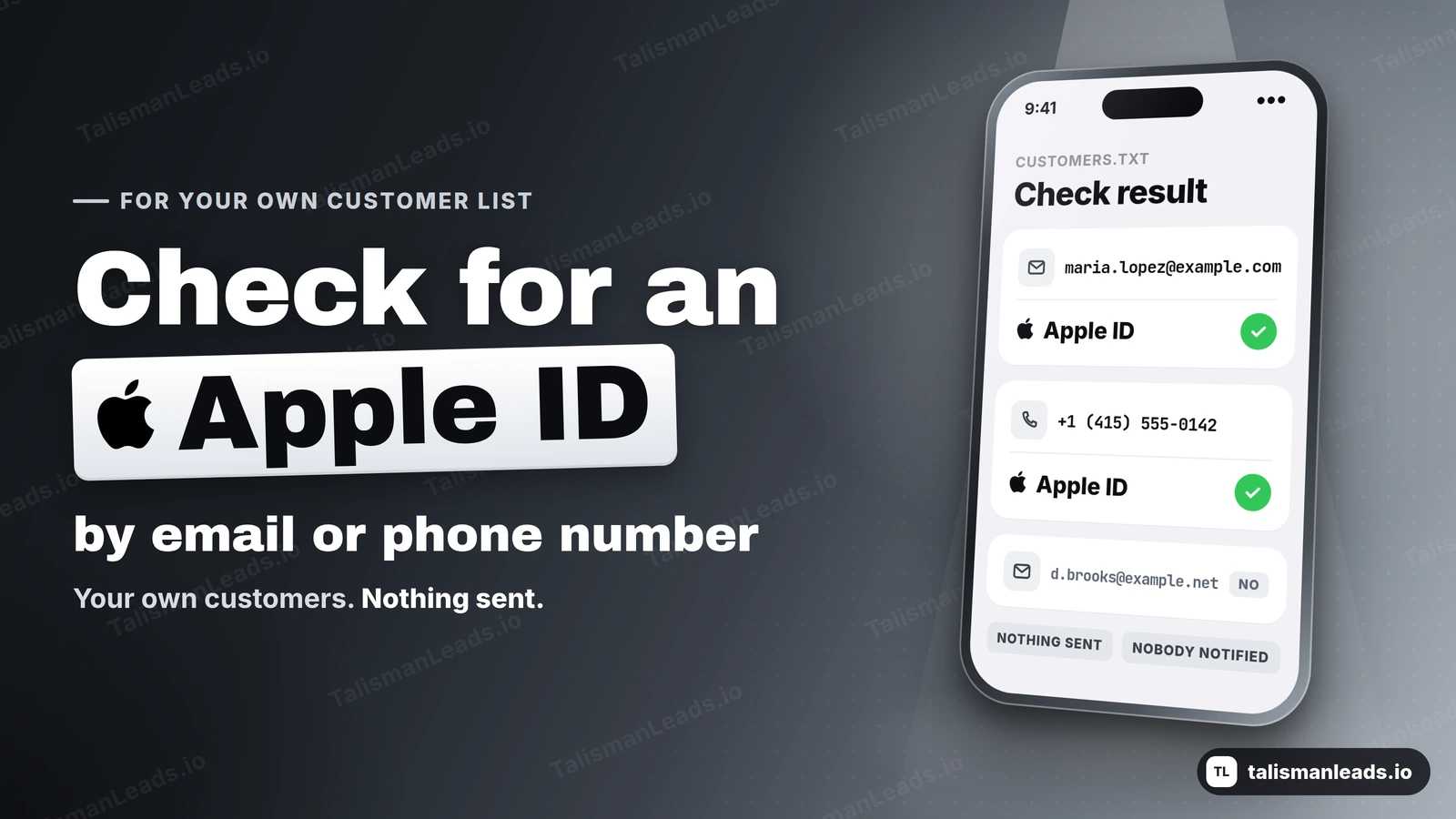
iMessage Number Checker, $3.50 per 10,000: marks each number registered or not registered with iMessage. A registered number points to an Apple device. "Not registered" does not prove Android: it can also be an iPhone with iMessage turned off, or a landline.
Number Carrier Lookup, $1.20 per 10,000, or free for 10,000 numbers a day with the Bulk Carrier Lookup: finds the landlines before anything else.
Upload a .txt file with one number per line and the country code (+14155550142). The exact price shows before you confirm, every file is billed as at least 2,000 numbers, and a check that cannot be completed is refunded. Businesses can test all three on their own list with a $5, 14-day free trial. Support changes as people switch phones and carriers, so check a list again before you reuse it, and only message customers who opted in.
Frequently asked questions#
Can iPhones receive RCS messages?#
Yes, since iOS 18 (September 2024), when the iPhone's carrier supports RCS. Between an iPhone and an Android phone, messages use RCS when both sides support it and SMS otherwise.
Can a business send iMessages to customers?#
Not to start a conversation. With Apple Messages for Business, customers start the chat from the business's website, app, Apple Maps or a QR code, and the business replies through an approved provider. There is no Apple service for bulk iMessage campaigns.
Do iPhones receive RCS business messages in the US?#
Yes, where the carrier supports it, and iPhone users can turn business RCS messages off in settings. Support varies by carrier, so business senders keep SMS as a fallback.
What happens if a customer's phone doesn't support RCS?#
The message should go as SMS instead. RCS providers offer this fallback, and checking your list first tells you how large each group is before you send.
Is a green bubble always SMS?#
No. On an iPhone, both RCS and SMS messages appear green. Only iMessage is blue.
Is RCS better than SMS for marketing?#
It does more: logos, photos, buttons and read receipts. But it needs a verified sender and reaches fewer numbers, so most businesses use RCS where it works and SMS for the rest.
How can I tell if a phone number has iMessage or RCS?#
Check it without sending anything: the iMessage and RCS checkers on TalismanLeads mark each number on your list, at $3.50 and $3.00 per 10,000 numbers.
Start with the RCS Number Checker to see how much of your list can get rich messages today.
Was this helpful?