How to Choose Messaging Channels for Your Customers
To choose messaging channels for your business, start from your own customers rather than national charts: measure what share of your list is on each app, decide what job the channel has to do, and weigh what each platform costs and allows. Give every candidate a simple score, reach × fit × ease, open the one or two at the top, and keep SMS and email for everyone else.
Below are the steps, a worked example, and links to each app's own guide.
Start from your own list, not national charts#
National figures tell you how many people use an app, not how many of your customers do. Pew Research Center found in 2025 that 32% of US adults use WhatsApp, and its 2024 survey found 54% of Hispanic adults and 51% of Asian adults using it. Your own customers can sit far above or far below an average like that.
So measure it. A registration check marks each of your customers' numbers registered or not registered on an app, without sending anything. Run it for each candidate app and you get one figure per app: the share of your list you could reach there. Read each figure as the least you can count on:
- It counts numbers, not people. A customer who joined with a different number reads as not registered.
- Registered is not active. For Telegram and Viber, an activity check shows who used the app recently, the better figure to plan on.
- Split before you average. Customers in different countries or segments often sit on different apps.
- It is a figure for today. Measure again before a big decision.
What each kind of channel is for#
An app that is right for one job can be useless for another, so sort the candidates by job first.
One-to-one service and updates#
Order updates, reminders and support conversations with customers who agreed to them.
- WhatsApp: a free Business app for a small team, and a Business Platform for sending at scale with approved message templates.
- Telegram: a bot can run support and send updates once the customer has started the chat.
- Viber: Business Messages, including promotions, to customers who opted in.
- LINE: an Official Account, the everyday choice for customers in Japan, Taiwan and Thailand.
- Messenger: the business replies within a window the customer opens; marketing messages go only to subscribers.
- Signal: person-to-person chats only; its terms rule out bulk and automated messaging.
Broadcast and content#
News, offers and content for customers who choose to follow you.
- Telegram channels: one-way broadcasts with no cap on subscribers.
- Instagram: posts and Stories; a business can message a customer only after the customer writes first.
- TikTok and Snapchat: short video and a free business profile, plus ads matched to your own customer list.
- Threads: publishing posts and managing replies.
Business to business#
LinkedIn is where companies and their buyers meet. LinkedIn prohibits automated messaging, so it is for a company Page, posts and personal outreach.
The baseline: SMS, RCS and iMessage#
Every mobile number can receive SMS, so it stays the fallback for every customer your chosen apps miss. RCS adds rich messages where phone and carrier support it, and iMessage is open to a business only when the customer starts the conversation. The comparison is in iMessage vs RCS vs SMS: What Your Customers Can Receive.
What each channel costs, in money and effort#
As each platform published it on November 23, 2026 (check again before you commit):
- WhatsApp: the Business app is free. On the Business Platform, Meta charges per delivered message, by category and the recipient's country; since October 1, 2026 only the first 1,000 service replies a month per number are free. Templates need Meta's approval.
- Messenger: the platform is free; marketing messages are charged per message.
- Telegram: the bot platform is free. Bots can broadcast about 30 messages a second; paid broadcasts in Telegram Stars lift that limit.
- Viber: Business Messages are paid per delivered message, and Viber's rate card adds a monthly minimum commitment fee.
- LINE: in Japan, an Official Account's plans run from free with 200 messages a month to ¥15,000 for 30,000; one-to-one chat and automatic replies are free.
- SMS and RCS: US business texting on a regular 10-digit number must be registered through your messaging provider before you send. RCS needs brand verification and launch approval.
- Instagram, TikTok, Threads and LinkedIn: no fee for a presence. A TikTok Business Account and a LinkedIn Page are free; the cost is content and any ads.
Effort often costs more than the fees: someone, or a bot, to answer within the reply window, templates to write and get approved, a steady supply of posts, and an opt-in step for every channel. A channel nobody answers does more harm than no channel.
Consent comes before any channel#
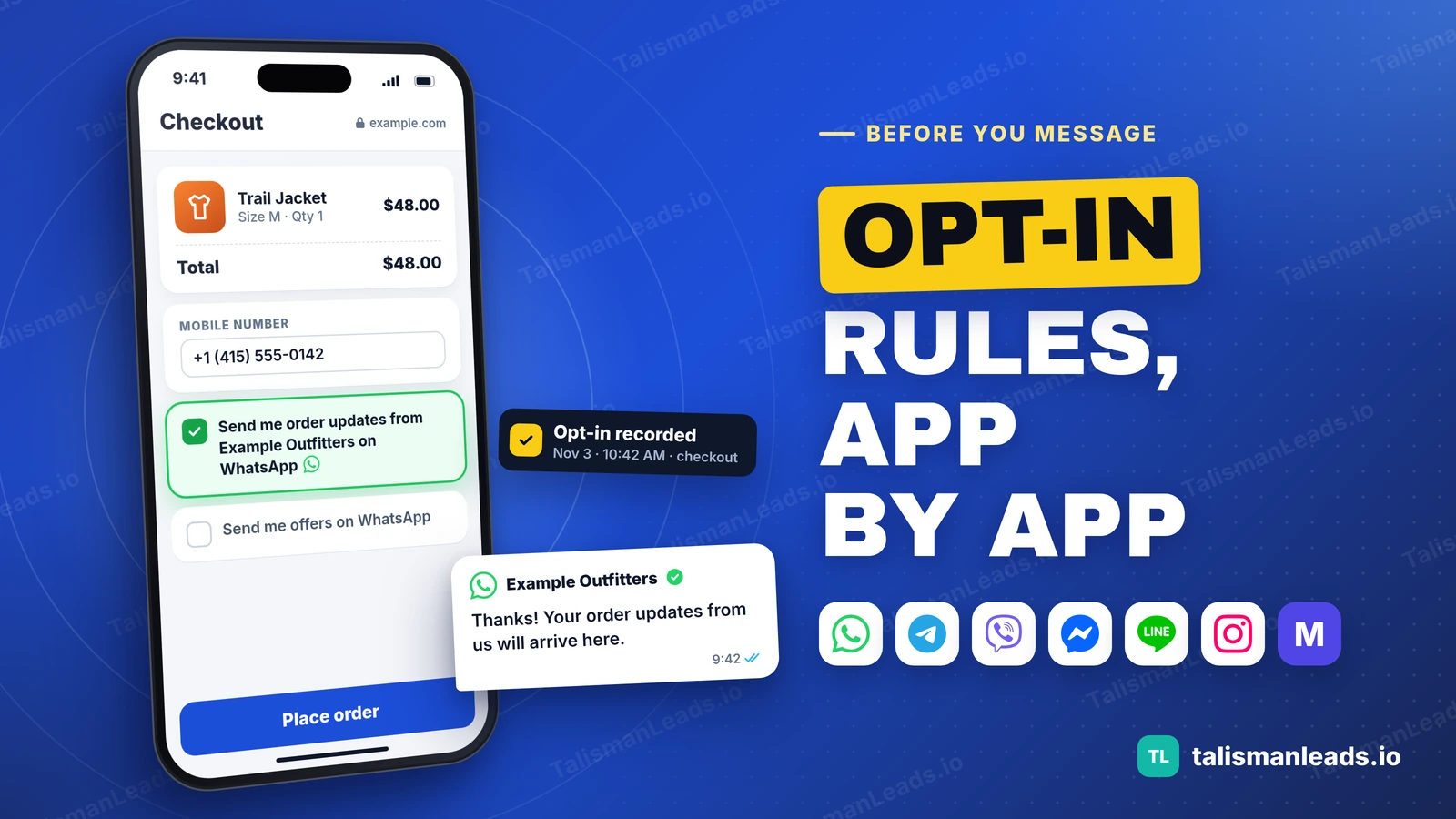
Being on an app is not permission to be contacted on it. WhatsApp wants an opt-in that names your business, a Telegram bot waits for the customer to start it, and Viber and Messenger marketing messages need the customer's agreement: the rules app by app are in Opt-In Rules on WhatsApp, Telegram, Viber and Other Apps. Whether you may check your list at all is answered in Is It Legal to Check If a Number Is on WhatsApp or Telegram?, and US texting rules in Do Not Call and TCPA for Phone Lists.
A measured share tells you where to invite customers, not whom to message: the step after choosing an app is an opt-in invitation at checkout, in your next email or on receipts.
Score each channel: reach × fit × ease#
Score each candidate for one job at a time, with three numbers:
- Reach: the share of your list registered on the app, from your check (38% is 0.38). Where an activity check exists, use the active share.
- Fit: 1 if the app lets a business do this job once the customer opts in; 0.5 if only partly, for example only inside a window the customer opens; 0 if the app offers a business no route at all.
- Ease: 0.9 if it is free with little setup; 0.6 if it means per-message fees, templates or approval; 0.4 if it means a partner contract or a monthly minimum.
Multiply the three together, then by 100. Open the channels at the top; leave any under about a third of the leader's score, and measure them again in six months.
A worked example#
Harbor & Pine Pet Supply is a fictional store in Tampa, Florida; every figure here is made up. It has 6,000 customers who gave a mobile number at checkout and agreed to order updates. For the job of updates and support replies, it checks the list on five apps:
- WhatsApp: 38% registered. 0.38 × 1 × 0.6 = 23
- Messenger: 31%. 0.31 × 0.5 × 0.9 = 14
- Telegram: 7%. 0.07 × 1 × 0.9 = 6
- Viber: 3%. 0.03 × 1 × 0.4 = 1
- Signal: 5%. No business route, so fit is 0: 0
The store opens WhatsApp first, asking for opt-in at checkout and by email, and adds a Messenger button to its website for customers who would rather write. Telegram waits for the next check; SMS covers the 62% not on WhatsApp.
Scored for a different job, posts and Stories, the same store's 46% on Instagram would put Instagram first, as a separate plan with its own budget.
Measure every app on your list with TalismanLeads#
TalismanLeads runs one registration check per app over a whole list, so the same customer file goes through each checker you need in one sitting. Nothing is sent and nobody is notified. Each number comes back registered or not registered, and the registered ones download as a separate list.
- WhatsApp Number Checker: $0.69 per 10,000 numbers
- Telegram Number Checker: $3.20 per 10,000 numbers
- Viber Number Checker: $5.00 per 10,000 numbers
- Messenger Number Checker: $5.00 per 10,000 numbers
- Signal Number Checker: $2.50 per 10,000 numbers
- LINE Profile Checker: $8.10 per 10,000 numbers
- Instagram Number Checker: $1.50 per 10,000 numbers
- TikTok Number Checker: $14.00 per 10,000 numbers
- LinkedIn Number Checker: $6.00 per 10,000 numbers
Threads, Snapchat, MAX, RCS and iMessage have checkers too, and Instagram and LinkedIn can also be checked by email. For Harbor & Pine, checking 6,000 numbers costs $0.42 on WhatsApp, $3.00 on Messenger, $1.92 on Telegram, $3.00 on Viber and $1.50 on Signal.
Three details make the figures more useful:
- One country per file. A phone checker refuses a file in which fewer than 90% of the numbers come from one country. Splitting a mixed list by country gives you a share per country, often where the real decision lies.
- Active, not just registered. A Follow-up Check runs a second checker on the registered numbers when the first finishes: Telegram Number Checker, then Telegram Activity Checker, gives the active share in one order.
- By API. A short script can place one order per checker for the same list of numbers through the TalismanLeads API.
You see the exact price before you confirm, every file is billed as at least 2,000 numbers, a failed check is refunded, and credit never expires. Businesses can try it with a $5, 14-day free trial.
Where each app's own guide goes deeper#
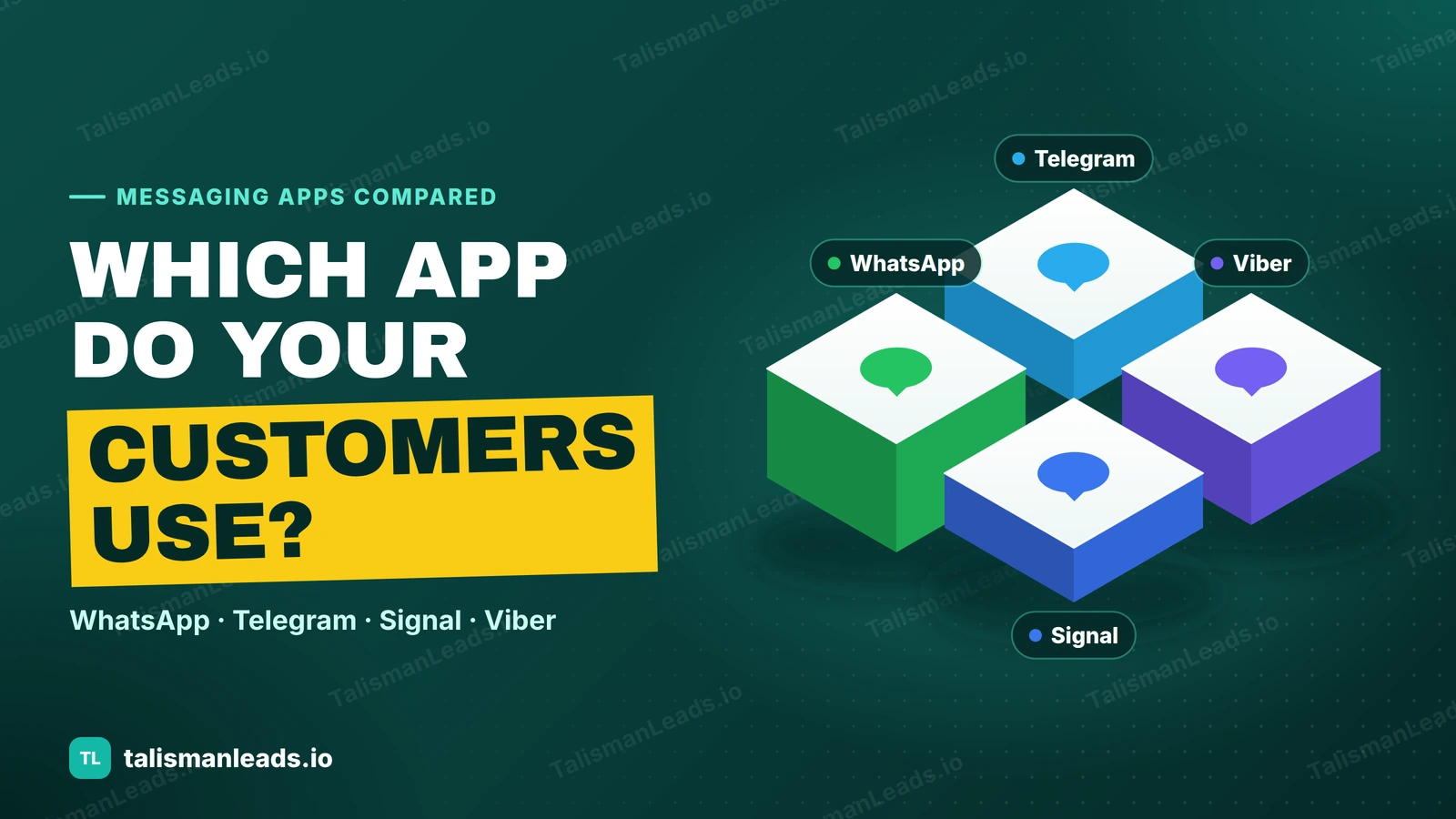
- WhatsApp vs Telegram vs Signal vs Viber for Business: the four apps' business rules side by side.
- How to Check Which of Your Customers Use WhatsApp and WhatsApp Lookup: What a Number Check Tells a Business, which also separates Business accounts from personal ones.
- How to Check If a Number Is on Telegram, in Bulk, with the activity check.
- How to Check If a Phone Number Is on Signal.
- How to Check If a Number Is on Viber, in Bulk.
- How to Check If a Number Has Facebook Messenger.
- How to Check If a Number Is on LINE, in Bulk.
- How to Check If a Number Is on MAX Messenger, in Bulk, for customers in Russia and nearby countries.
- Which Customers Are on Instagram, LinkedIn or Threads? and Which Customers Are on TikTok or Snapchat?
Frequently asked questions#
How many messaging channels should a small business use?#
Usually one or two messaging apps plus SMS and email. Add an app only when its score clears about a third of the leader's and you have the people to answer it.
Can I message customers on an app once the check shows they are registered?#
No. Registration shows where a customer could be reached, not that they agreed to hear from you there. Invite them to opt in first, under that app's rules.
How often should I measure my list again?#
Before any big decision, and about twice a year for apps you left out. Shares change as customers join and leave apps and as your list grows.
Is SMS still worth it if most customers use WhatsApp?#
Yes. SMS reaches every mobile number, so it covers the customers who are not on your chosen app or have not opted in there.
Start with the checkers catalog and measure your own list on the apps you are weighing.
Was this helpful?